Global Mirror Market Focus: Costa Rica Strengthens Import Links with China and the U.S.

Publishing Date:2026-01-08 16:21:07 Source: NBD Data(en.nbd.ltd)

The trade flow of mirrors under HS Code 700992000000 — known in Spanish as ESPEJO — shows that Costa Rica has significantly expanded its import activity in the first half of 2025. According to NBD DATA, between January and June 2025, Costa Rica imported mirrors worth USD 1.99 million, with 5,853 shipments, involving 783 importers and 400 exporters across 47 supplier countries. Examples from customs records include metal floating mirrors, wood-framed mirrors, and portable LED mirrors, illustrating the variety of products entering the market.

Monthly Import Overview

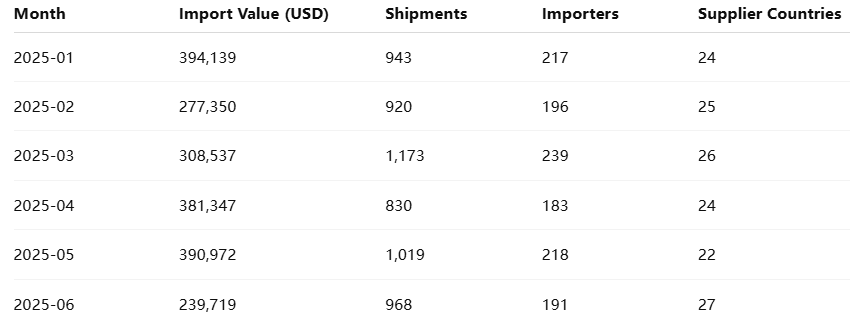
Costa Rica’s mirror imports remained steady throughout the first half of 2025, with slight fluctuations from month to month:

The import value peaked in May 2025 at nearly USD 391 thousand, with consistently active importer participation. This stability reflects growing domestic demand for mirrors used in furniture, retail, and home décor sectors.

Market Observation

The mirror market in Costa Rica during early 2025 was shaped by collaboration between local distributors and global suppliers. Leading importers included

who imported diverse mirror products from Asia and the United States.

On the supplier side, prominent exporters were

These companies handled hundreds of mirror shipments, covering categories such as bathroom mirrors, wall mirrors, and metal-framed decorative mirrors. Their diversified sourcing strategies targeted the retail, construction, and hospitality markets.

Regional Trade Links

Costa Rica’s mirror imports were dominated by China and the United States, which together supplied most of the shipments:

  • China led with over USD 1.12 million in mirror exports, totaling more than 293,000 units.

  • The United States ranked second with USD 421 thousand, primarily providing high-end and designer mirrors.

Other contributing countries included Panama, Spain, Mexico, and France, each catering to niche decorative segments. This supplier mix highlights Costa Rica’s balanced sourcing strategy — combining cost-effective Asian manufacturing with premium Western designs.

Focus on China

China’s strong position stems from its integrated production chain for glass and metal-based mirror products. Imports included arched metal floating mirrors, Lucent leaner mirrors, and round metal framed mirrors from regions such as Yiwu and Ningbo. These products align with global home décor trends that emphasize minimalist design and affordability, reinforcing China’s dominance in Costa Rica’s mirror import market.

Summary

In conclusion, Costa Rica’s mirror imports under HS Code 700992000000 maintained stable growth in early 2025. With a total value close to USD 2 million and coverage across 47 countries, the trade remained concentrated on China and the United States. The demand pattern reveals a preference for diverse, design-oriented products, supported by consistent importer activity.

As the domestic home décor and retail sectors continue to expand, Costa Rica is expected to sustain its import demand for mirrors, creating opportunities for suppliers across Asia and North America. For more detailed insights, visit the NBD DATA Service Center.

Related Recommendations

Offer

Half-Year Review: The Expanding Fan Import Market in Peru’s Consumer Electronics Sector

2026-01-05 14:08:12

During the first half of 2025, Peru’s import market for electric fans (HS 8414510000) recorded remarkable activity, reflecting both a growing consumer demand for home appliances and the increasing penetration of portable and smart ventilation devices. According to NBD DATA, Peru imported electric fans worth USD 6.03 million between January and June 2025, encompassing more than 1.45 million units across 1,704 shipments, sourced from 26 partner countries and handled by 355 importing companies.Under the Harmonized System, HS 8414510000 represents “Fans, table, floor, wall, window, ceiling or roof, with a self-contained electric motor of an output not exceeding 125 W.” Based on sampled customs descriptions—such as “VENTILADOR DE MANO MINISO,” “VENTILADOR INDUSTRIAL JASON FAN,” and “Ventilador de pie inteligente Xiaomi”—imports during this period included a wide array of products ranging from mini USB fans and desktop devices to smart standing fans and industrial cooling units.For further reference, readers can explore HS 8414510000 detailsand the keyword VENTILADORon the NBD platform for up-to-date trade information and market data.Market Overview and ScaleFrom January to June 2025, Peru imported USD 6.03 million worth of electric fans, totaling approximately 1.46 million units. This reflects the country’s strong retail and consumer electronics distribution channels, as well as active imports of both budget and branded fan products.Total import value: USD 6,027,857Total shipments: 1,704Total units: ≈1.46 million piecesImporters: 355Partner countries: 26The variety of imported items underscores Peru’s dual demand structure: a low- to mid-range consumer market dominated by affordable portable fans and a smaller premium segment represented by global brands like Xiaomi, Midea, and Premier. Retailers and wholesalers alike benefited from the hot summer months in early 2025, which spurred seasonal purchasing.Monthly Import TrendThe half-year data reveal strong import volumes in January and February, followed by a gradual moderation through April, and then a mild recovery by June.The peak in January 2025 corresponds to pre-summer inventory buildup among electronics retailers, accounting for over 50% of total import value in the period. Imports subsequently stabilized between March and June, reflecting the cyclical nature of demand in Peru’s consumer appliance market.Overall, the trend indicates that fan imports are heavily season-driven, with importers stocking up before the high-temperature months, followed by a gradual decline as domestic inventory levels stabilize.Key Importers in PeruPeru’s electric fan market is characterized by a large number of importers, yet a small group of companies dominates overall trade value. The leading importers include:IMPORTACIONES HIRAOKA S.A.C.– One of Peru’s top electronics retailers, primarily from Asian manufacturers such as Midea Electric and Hefei Hualing.TIENDAS DEL MEJORAMIENTO DEL HOGAR S.A.– A major retail chain, with sourcing from Guangdong Sunrise Houseware and ZHONGSHAN YUFENG.CORPORACION CHEN S.A.C.– Focused on mid-range home appliances.MANGO SOL S.A.C.– Importer of small fans and accessories s.SOLANA COMERCIAL S.A.C.– Wholesaler of general merchandise and electronics.These companies play distinct roles: HIRAOKA and Tiendas del Mejoramiento lead in retail distribution; CORPORACION CHEN and MANGO SOL serve smaller domestic markets; and SOLANA COMERCIAL functions as a hybrid importer and wholesaler for general retail chains. Collectively, they represent the backbone of Peru’s home appliance import and distribution network.Supplier Structure and Trade OriginsUnlike the concentrated importer side, Peru’s supplier network is relatively diverse, encompassing 117 exporters from 26 countries.The leading source countries include:China, supplying over 80% of imported fans, particularly USB, portable, and industrial models.Hong Kong(China) and Singapore, acting as re-export hubs for Asian-manufactured goods.Mexico and the United States, exporting higher-end and branded products.Germany and Italy, focusing on industrial and ventilation systems.The presence of well-known Asian brands such as Xiaomi, Midea, Autotech, and Jason Fan highlights Peru’s growing preference for modern, energy-efficient, and smart ventilation products.Market Segmentation and Product DiversityThe customs descriptions indicate significant segmentation in Peru’s fan imports:Portable and USB fans – popularized by brands such as Miniso and Mumuso, targeting retail consumers.Smart standing and tower fans – including Xiaomi Smart Fan 1C/2 Pro models, appealing to middle- and upper-income households.Industrial and axial fans – branded as Jason Fan or Holafan, used for refrigeration, machinery, and ventilation systems.Cooling accessories for electronics – such as XTech laptop cooling pads and ABB inverter fans, representing industrial B2B demand.This wide product range reflects Peru’s mixed consumption profile—mass-market affordability coexists with technological sophistication.Market InsightsPeru’s electric fan import landscape in the first half of 2025 reveals several key industry dynamics:Seasonality: Demand peaks in the first quarter due to summer heat waves and promotional retail cycles.Market concentration: The top ten importers account for roughly 60% of total import value.Asian dominance: Over four-fifths of imported units are sourced from China and its trade hubs.Product innovation: The growth of rechargeable, USB, and smart fans shows Peru’s transition toward energy-efficient, portable solutions.Furthermore, the presence of established global electronics brands strengthens consumer trust and drives the replacement cycle, especially within Peru’s urban markets such as Lima, Arequipa, and Trujillo.Regional and Economic PerspectivePeru’s expanding middle class and rising household appliance ownership rates have contributed to sustained growth in small appliance imports. Retail infrastructure—spanning malls, e-commerce platforms, and department stores—has played a central role in distributing imported fans nationwide.With a warm tropical climate across many regions, Peru maintains consistent year-round demand for ventilation products, but major import surges are concentrated between December and February, when importers prepare for the southern hemisphere summer.Summary and OutlookIn summary, Peru’s electric fan imports under HS 8414510000 experienced a strong start to 2025, driven by pre-summer retail expansion and the broad availability of affordable Chinese-made devices. With total imports of USD 6.03 million and more than 1.45 million units, the first half of the year underscored Peru’s status as a key Latin American market for consumer electronics and small appliances.Looking ahead, sustained urbanization, household modernization, and brand diversification will likely continue fueling the market. Importers are expected to expand product offerings toward smart, rechargeable, and energy-saving models, aligning with consumer preferences for portability and efficiency.Data SourceThis analysis is based on official trade data from NBD DATA, covering Peru’s imports of HS 8414510000 (Electric fans, ≤125 W) between January and June 2025. For tailored trade data services and supplier identification, visit NBD DATA Service Center....

Offer

Inside Botswana’s Medical Devices Market: Import Dynamics and Key Players

2026-01-05 13:06:09

Botswana’s import landscape for Medical Instruments and Appliancesunder HS Code 90189000reflects an evolving healthcare infrastructure powered by regional and global supply chains. According to trade data from NBD DATA, the country’s imports between January and June 2025 totaled approximately USD 1.29 million, encompassing over 274,000 units of medical equipment and devices. These figures underline Botswana’s steady demand for medical and surgical instruments vital for hospitals, clinics, and diagnostic centers nationwide.Common imported items included general-purpose medical tools and devices used in surgical, dental, and diagnostic applications, reflecting investment in both private and public health sectors.Monthly Import TrendsThroughout the first half of 2025, Botswana maintained a consistent pace in importing medical instruments, with trade activity peaking in March and April. Import values ranged from USD 145,000 to nearly USD 300,000 monthly.The distribution indicates that March was the busiest month, accounting for over 23% of total imports. The slight decline in May–June points to seasonal adjustments in procurement or customs scheduling rather than reduced demand.Market ObservationMajor ImportersBotswana’s medical devices market is led by prominent healthcare institutions and specialized distributors. The top importers in the first half of 2025 included:HEALTHCARE MANAGEMENT SERVICES (PROPRIETARY) LTD.LENMED HEALTH BOKAMOSO PRIVATE HOSPITAL (PROPRIETARY) LTD.CHUBBS BOTSWANA (PROPRIETARY) LTD.TATI RIVER CLINICS (PROPRIETARY) LTD.FINE PHARMACEUTICALS (PROPRIETARY) LTD.These organizations form the backbone of Botswana’s healthcare procurement ecosystem, supplying hospitals and clinics across Gaborone, Francistown, and Maun.Key SuppliersSouth Africa emerged as Botswana’s dominant trade partner, leveraging its established medical manufacturing and distribution networks. The leading foreign suppliers included:JOHNSON & JOHNSON S.A.RESPIRATORY CARE AFRICA (PTY) LTD.GLOBUS MEDICAL SOUTH AFRICADRAGER SOUTH AFRICA (PTY) LTD.BECTON DICKINSON PTY LTD.These companies accounted for a substantial share of imports, providing advanced devices ranging from surgical tools to respiratory care equipment.Regional Trade DistributionBotswana’s import pattern demonstrates a clear reliance on regional medical supply chains, particularly from South Africa, the nation’s primary supplier of healthcare equipment. Other contributors included the United States, Germany, and China, supplying diagnostic instruments and specialized devices.South Africa’s proximity and logistics efficiency make it the preferred source for both high-end and routine medical products. The cross-border collaboration ensures timely delivery, after-sales service, and regulatory compliance aligned with Southern African Development Community (SADC) standards.Product ExamplesRepresentative medical devices imported into Botswana during this period included:Surgical and dental instrumentsDiagnostic devices for laboratory useRespiratory care equipmentElectromedical appliances and hospital accessoriesThese products fall under the broader category of “instruments and appliances used in medical, surgical, dental, or veterinary practices,” emphasizing their role in supporting the country’s growing healthcare infrastructure.Market InsightsBotswana’s healthcare sector is in an expansion phase, driven by population growth, modernization of hospitals, and public health investments. Imports of medical instruments have become an essential part of this transformation, with regional suppliers bridging supply gaps.The data shows a balanced and diversified importer base, from large private hospitals like Bokamoso to specialized clinics such as Tati River Clinics. This diversity ensures competitive sourcing and improved access to modern medical technologies.ConclusionBotswana’s medical instruments import market demonstrates a robust regional integration model. South African companies remain the core suppliers, while global brands such as Johnson & Johnson, Dräger, and Becton Dickinson strengthen supply reliability.With continued investment in healthcare facilities and government procurement programs, Botswana’s import volume for medical devices is likely to sustain growth. The country’s increasing emphasis on modern surgical and diagnostic solutions underscores its commitment to advancing medical care for its citizens.Data and insights provided by NBD DATA. For professional market analysis and enterprise-level trade intelligence, please visit our service page....

Offer

Indonesia’s Cosmetic Export Momentum: Lotion Products Leading the Charge

2026-01-05 11:50:07

Indonesia’s cosmetic industry has continued to show dynamic growth, with HS Code 33049930— encompassing lotion products — emerging as one of the nation’s most internationally competitive categories.According to NBD DATA, Indonesian lotion exports surged across 2024, with brands like KRIS Hand & Body Lotion and CITRA Hand Body Lotion Natural Glow UV representing the diverse range of skincare items being distributed globally. These products highlight Indonesia’s rising capacity to supply affordable yet high-quality personal care solutions to the global market.I. Export OverviewIn 2024, Indonesia’s lotion exports reached a total value of USD 14.77 million, with an export weight of approximately 6,933 tons. Throughout the year, there were 3,204 trade transactions involving 146 exporters and 388 importers, spanning 61 destination countries.This wide distribution underscores Indonesia’s established position as a key skincare exporter within ASEAN and beyond, supported by efficient manufacturing, strong branding, and flexible trade routes.Among the exported items, notable examples include:“KRIS Hand & Body Lotion (100 ML X 72 PCS / Carton) – Fresh Hydration”“CITRA Hand Body Lotion Natural Glow UV 4X6X210ML”“NIVEA Body Lotion UV Extra Whitening 200MLX24”These products exemplify Indonesia’s shift toward diversified, consumer-oriented skincare goods targeting both premium and mass-market segments.II. Monthly Export TrendsBased on NBD DATA, Indonesia’s lotion exports remained stable throughout the year, with visible peaks in January, August, and December — driven by pre-holiday demand in Asia and the Middle East.Exports peaked in December (USD 1.86 million), which aligns with global holiday sales. The lowest export period occurred in April, coinciding with Ramadan production slowdowns. The recovery in the second half of the year signals robust international demand for Indonesian lotion products, particularly in ASEAN and Middle Eastern markets.III. Market Observation: Buyers and SuppliersTop Global BuyersAccording to verified NBD DATA, the largest buyers of Indonesian lotion products in 2024 included both multinational brands and regional distributors:L'OREAL (THAILAND) LIMITED– imported over 1,027 tons , mainly through its Indonesian subsidiary PT. YASULOR INDONESIA.VENUS BEAUTY PTE LTD.– a Singapore-based retail distributor sourcing from multiple Indonesian cosmetic producers.TEMPO SCAN PACIFIC PHILIPPINES INC.– part of the Tempo Scan Group, one of Southeast Asia’s major beauty product distributors.MODERN SY SDN BHD (1403898-V)– Malaysia-based wholesaler specializing in cosmetic imports.NURBB TRADING SDN BHD (1395809H)– a key intermediary for re-exporting Indonesian lotion products to Brunei and the Philippines.These buyers account for the majority of regional trade flows, emphasizing ASEAN’s role as the largest consumer and distribution base for Indonesian skincare goods.Leading Indonesian ExportersThe supplier side is characterized by both multinational manufacturing arms and independent exporters:PT. SPARINDO MUSTIKA– the top exporter, serving partners across the Middle East and ASEAN.PT. YASULOR INDONESIA– a manufacturing subsidiary of L’Oréal Indonesia, the Philippines, and Malaysia.PT. RAJA IMPEX– a major contract manufacturer and exporter focusing on private-label lotion production.PT. RUDY SOETADI– an experienced exporter serving regional personal care distributors.SENSATIA BOTANICALS– Bali-based natural skincare producer, exporting boutique batches to Japan, Singapore, and Europe.Notably, these companies maintain diversified export portfolios, ranging from mass-market lotion products to niche organic formulations, ensuring resilience against global price fluctuations.IV. Regional Trade AnalysisIndonesia’s lotion exports covered 61 countries, but the majority of shipments concentrated in Asia and the Middle East.The top importing regions and their trade shares are as follows:The United Arab Emirates has become Indonesia’s largest lotion import hub, often serving as a gateway for re-exports to Saudi Arabia and Africa.Meanwhile, Thailand and Singapore remain dominant within ASEAN, importing both for local consumption and for redistribution through multinational supply chains.Indonesia’s strong ties with these markets are reinforced by free trade agreements and proximity logistics advantages, allowing exporters to maintain competitive pricing while adhering to diverse regional cosmetic regulations.V. Focus Country: China Market OutlookFollowing the rules for export data, the focus country is China, where Indonesian lotion exports primarily cater to mid-tier retail channels and e-commerce importers.Although China is not yet a top-five destination, demand for halal-certified and botanical-based skincare from Indonesia is increasing.Products from PT. SPARINDO MUSTIKAand SENSATIA BOTANICALSare now visible in cross-border online marketplaces such as Tmall Global and Lazada CN.This emerging channel indicates significant future potential for Indonesia’s lotion exports into the Chinese skincare segment, especially for natural and sustainable product lines.VI. Industry Insights and Future TrendsASEAN Integration Strengthens Export SynergiesRegional trade agreements and reduced tariffs under RCEP have simplified distribution for Indonesian cosmetic goods, encouraging cross-border brand collaborations within Southeast Asia.Halal and Eco-Certification Drive Market AccessOver 60% of Indonesian lotion exports are now halal-certified, giving them a unique advantage in the Middle East and Muslim-majority markets. The increasing adoption of recyclable packaging also appeals to European importers.Brand Development and Digital ChannelsExporters like SENSATIA BOTANICALS leverage digital storytelling and influencer marketing to expand brand visibility, while manufacturers such as PT. SPARINDO MUSTIKA invest in co-branding with overseas distributors.Rising Competition and Supply Chain ChallengesGlobal skincare demand is expanding, but so is competition. Exporters face pressure from Vietnamese and Malaysian cosmetic producers. Rising palm oil prices — a key raw material — may affect production costs.Outlook for 2025With expected GDP growth and digital trade expansion, Indonesia’s lotion exports are forecast to grow by 10–12%, particularly through online retail and private-label manufacturing contracts.VII. ConclusionThe lotion export segment showcases Indonesia’s evolving cosmetic export ecosystem — a blend of industrial scale, creativity, and regional integration.From mass-market formulations by PT. YASULOR INDONESIAto organic brands like SENSATIA BOTANICALS, the sector demonstrates flexibility in meeting diverse global demands.ASEAN and the Middle East remain the key growth anchors, while the emerging Chinese market offers fresh momentum for 2025 and beyond.Indonesia’s continued investment in quality standards, sustainable packaging, and halal compliance ensures its position as a global skincare manufacturing hub.VIII. Data SourceAll data and company records are derived from NBD DATA, based on Indonesia’s 2024 export transactions of LOTION (HS Code 33049930).Figures originate from verified customs declarations and NBD’s global trade intelligence platform, including transaction totals, partner countries, and verified exporter IDs.For enterprise-level data access, shipment verification, or importer profiling, please visit NBD DATA Services....