
Analyzing Ecuador’s Router Import Market: Top Buyers, Global Suppliers, and Industry Shifts
Between January and June 2025, Ecuador’s import activity for Routers under HS Code 8517629000
Monthly Import Overview
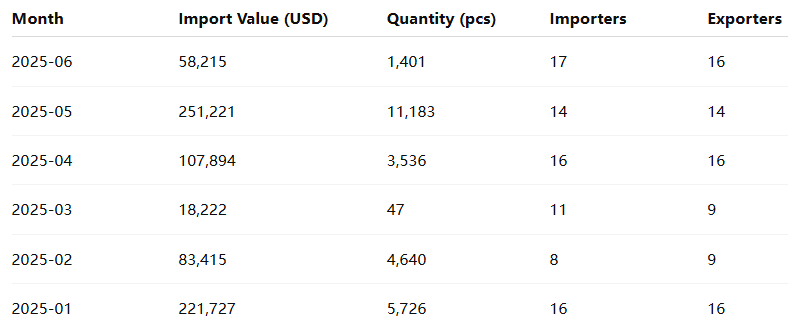
Ecuador’s imports peaked in May 2025, when total router purchases exceeded USD 250,000, primarily driven by large-scale telecommunications and retail distributors preparing for midyear network expansion projects.
Market Overview
Ecuador’s demand for routers is closely tied to the expansion of broadband services, the modernization of local ISPs, and the growing penetration of satellite-based internet systems. The country’s telecom infrastructure modernization and Starlink’s regional rollout have created a competitive environment for both global and local suppliers.
In the first half of 2025, more than 26,500 routers were imported, with a total weight of 15.4 tons. While large imports were handled by nationwide distributors, smaller batches were purchased by retailers and service providers targeting urban and rural connectivity programs.
Major Importers
Ecuador’s router market is characterized by a mix of telecom operators, ICT distributors, and consumer electronics firms. Leading buyers include:
-
CONSORCIO ECUATORIANO DE TELECOMUNICACIONES, S.A. CONECEL — Ecuador’s largest telecom company, imported over USD 1.97 million worth of routers from ZTE, Huawei, and Sanmina-SCI Mexico for national mobile and broadband infrastructure upgrades.
-
ZC MAYORISTAS S.A. — a wholesale technology distributor, imported USD 1.2 million worth of routers from Ruijie Networks, TP-Link, and MikroTik, covering enterprise and home networking devices.
-
INTCOMEX DEL ECUADOR S.A. — a key IT and electronics wholesaler, imported USD 597,000, primarily from Software Brokers of America (INTCOMEX Group) in Miami and Panama.
-
ELECTRONICA SIGLO XXI ELECTROSIGLO S.A.
— focused on consumer electronics, imported USD 283,000 worth of TP-Link routers for retail distribution. -
STARLINK ECUADOR STAREC C.LTDA. — imported USD 20,852 of networking equipment directly from SpaceX, marking the growing presence of satellite internet solutions in Ecuador.
These companies collectively dominate the market, supplying over 80% of Ecuador’s imported routers in early 2025.
Major Exporting Partners
Ecuador’s router imports are sourced from a combination of Asian technology leaders and North American distributors. Key suppliers include:
-
ZTE CORPORATION and HUAWEI INTERNATIONAL PTE LTD. — providing high-capacity routers for mobile network operators.
-
LIANZHOU TECHNOLOGIES CO., LTD. — representing TP-Link, a leading provider of consumer-grade networking products.
-
RUIJIE NETWORKS CO., LTD.
— supplying enterprise routers and access points for education and government projects. -
MIKROTIKLS SIA — Latvia-based supplier of professional routers used by small ISPs and system integrators.
-
SOFTWARE BROKERS OF AMERICA INC. (INTCOMEX) — acting as a key logistics hub for products sourced from Cisco and other U.S. vendors.
The supply chain diversity illustrates Ecuador’s reliance on both high-end professional networking equipment and cost-efficient retail models.
Industry Dynamics and Trade Trends
Ecuador’s router market in 2025 reflects a broader regional digitalization effort. Key trends include:
-
Telecom infrastructure modernization — led by CONECEL and CNT (Corporación Nacional de Telecomunicaciones), driving high-volume imports of industrial-grade routers.
-
Expansion of home broadband and fiber connectivity — boosting demand for mid-range routers from TP-Link, MikroTik, and Huawei.
-
Emergence of satellite internet — with Starlink’s operations increasing demand for compatible network devices.
-
E-commerce and retail tech distribution — companies like ZC Mayoristas and INTCOMEX are bridging the gap between global suppliers and local resellers.
These dynamics have positioned Ecuador as a growing market for both enterprise-grade and consumer-level networking devices.
Regional Trade Context
Ecuador’s router imports mainly originate from China, Mexico, and the United States, reflecting its hybrid sourcing structure: China provides large volumes of cost-effective devices, while the U.S. and Mexico contribute higher-end and OEM routers for telecom networks.
Regional trade partners like Panama and Chile serve as logistical intermediaries, facilitating re-exports from U.S. distributors to Ecuador’s wholesalers.
This trade structure aligns Ecuador with the broader Latin American telecommunications ecosystem, where cross-border collaboration supports technology accessibility and infrastructure upgrades.
Market Outlook
With the government’s continued focus on connectivity expansion and digital inclusion, Ecuador’s router imports are expected to maintain steady growth through 2025. Upcoming 5G pilot projects and rural internet initiatives are likely to drive sustained demand for both wireless and wired routers.
Industry experts anticipate a shift toward:
-
Integration of Wi-Fi 6 and mesh networking solutions,
-
Partnerships with global tech firms for infrastructure upgrades, and
-
Increased local assembly or regional distribution to reduce import dependency.
Conclusion
Ecuador’s router import market in early 2025 showcases a robust interplay between global technology brands and local distributors. Major players like CONECEL, ZC Mayoristas, and INTCOMEX are shaping the nation’s digital connectivity landscape, supported by suppliers from China, the U.S., and Europe.
As Ecuador deepens its commitment to nationwide internet access, the router market will continue to evolve — blending affordability, technological innovation, and regional integration.
Data source: NBD DATA