
Analyzing the U.S. Lithium-Ion Battery Import Market: Key Players and Trade Trends in 2025
In the first half of 2025, the U.S. import market for lithium-ion batteries (HS Code 850760) maintained robust momentum, driven by the growing adoption of electric vehicles, energy storage systems, and portable electronics. According to NBD DATA
Typical declarations included product descriptions such as “LITHIUM-ION BATTERY PACK HS CODE 8507600090”, “PORTABLE POWER STATION LITHIUM ION BATTERIES”, and “LITHIUM IRON PHOSPHATE BATTERY HS:8507600090”, highlighting the broad applications of these products across industries.
Monthly Trade Overview
U.S. imports of lithium-ion batteries under HS 850760 displayed steady volumes through the first half of 2025. According to NBD DATA, the number of monthly transactions ranged from 171 to 306, showing an upward trajectory in April and June. Overall, 782,986 units were imported during this period, reflecting a clear rise in demand across industrial and consumer sectors.
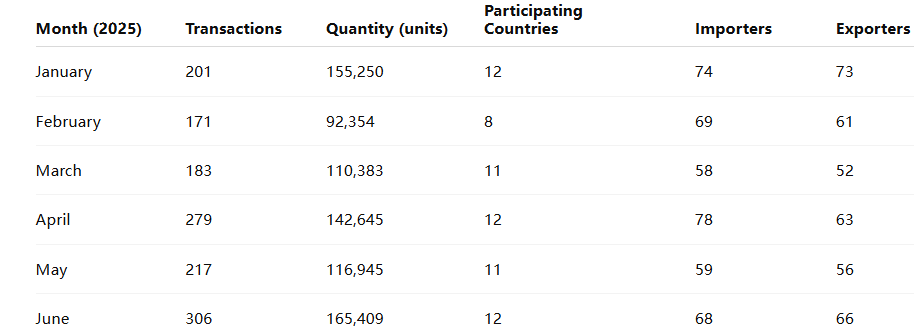
The month-to-month increase in both transaction count and shipment quantity suggests sustained restocking activity among U.S. manufacturers and distributors, especially in the EV and renewable energy sectors.
Market Observation: Major Importers and Trade Networks
Based on NBD DATA
DELTA ELECTRONICS (AMERICAS) LTD. remained one of the largest importers, sourcing primarily from Delta Electronics Inc. in Asia. The company’s import activity reflects a vertically integrated supply chain, supporting its U.S. operations in energy systems and power management products.
RIVIAN AUTOMOTIVE, LL Calso ranked among top importers, bringing in high-performance cells mainly from Samsung SDI Co., Ltd. These imports are critical for Rivian’s EV production lines, reinforcing its manufacturing base in North America.
ECOFLOW TECHNOLOGY INC. demonstrated strong import activity, exceeding fifty thousand battery units from Hong Kong EcoFlow Innovation Technology. The firm’s shipments emphasize its leadership in portable power and home energy storage products.
GROWATT USA INC. focused on solar energy storage systems, importing more than twenty thousand units from Shenzhen Growatt New Energy Co., Ltd. These imports highlight the integration of lithium batteries into solar inverter and hybrid energy systems.
TRIATHLON BATTERY SOLUTIONS continued stable imports from its German counterpart Triathlon Batterien GmbH, supplying industrial and traction battery applications across the U.S. and Europe.
Together, these enterprises reflect the U.S. market’s multi-layered demand: automotive, renewable, industrial, and consumer segments are all contributing to the sustained inflow of lithium-ion battery products.
Exporting Partners and Global Supply Chain
Among the 210 exporters supplying lithium-ion batteries to the U.S. in 2025, the majority were based in China, South Korea, and Germany—the world’s core manufacturing hubs for advanced battery technologies. Chinese suppliers dominated in shipment volume, exporting a wide range of lithium battery packs and modules, including LiFePO₄ and polymer-based types.
Korean and Japanese exporters, led by Samsung SDI and Panasonic, specialized in high-performance EV-grade cells and energy-dense storage systems, while German firms like Triathlon Batterien GmbH supported the U.S. market with premium industrial batteries.
This trade structure underscores the global interdependence of the battery industry—Asia as the production center, Europe as a technology hub, and the United States as a major end-market and system integrator.
Trade Regions
The United States imported lithium-ion batteries from 16 source countries in the first half of 2025. China remained the dominant origin, followed by South Korea, Vietnam, Japan, and Germany. These nations represent the key nodes in the global lithium-ion supply chain.
China’s dominance reflects its massive manufacturing base and competitive export prices. In contrast, imports from Japan and South Korea tend to serve high-end applications requiring advanced chemistry and quality consistency. Germany’s contributions—primarily from Triathlon and other European suppliers—reflect the ongoing transatlantic cooperation in industrial energy storage technologies.
Technical and Product Variety
Customs data reveal that imported lithium-ion batteries encompass a broad range of technologies and product types. Representative shipment descriptions include:
-
“TOSHIBA SCIB™ Lithium-Ion Battery HS CODE: 8507.60 (CLASS9/UN3480)”
-
“RECHARGEABLE LITHIUM-ION BATTERY PACK HS CODE850760 UN 3480 CLASS 9”
-
“PORTABLE POWER STATION LITHIUM ION BATTERIES (INCLUDING POLYMER TYPES)”
These records confirm the diversity of imported products, covering everything from EV traction batteries and industrial energy storage modules to consumer-grade portable systems.
Market Dynamics and Industrial Implications
Analysis of early 2025 import data highlights several major trends:
-
Diversified Supply Chains – U.S. companies are actively sourcing from multiple Asian markets to mitigate geopolitical and logistics risks.
-
Acceleration of Electrification – Import growth from EV producers such as Rivian demonstrates expanding production capacity and the strengthening of local assembly ecosystems.
-
Rise of Distributed Energy – Companies like EcoFlow and Growatt are driving imports of residential and portable energy storage systems, meeting the fast-growing off-grid energy demand.
-
Integrated System Imports – Many shipments include batteries alongside inverters or chargers, signaling a move toward system-level procurement in the clean energy sector.
These dynamics collectively reveal a rapidly maturing market in which lithium-ion batteries form the technological and strategic backbone of U.S. industrial transformation.
Summary
Between January and June 2025, the United States imported nearly 783,000 battery units under HS Code 850760, across more than 1,300 shipments. This sustained inflow highlights the country’s expanding capacity in electric mobility and renewable energy.
Leading importers—DELTA ELECTRONICS (AMERICAS), RIVIAN AUTOMOTIVE
In essence, the lithium-ion battery trade mirrors the broader energy transition—integrating global manufacturing networks, advancing clean technologies, and reinforcing industrial resilience in the United States.
Data Source
All data and company information in this report are sourced from NBD DATA