
Botswana’s Footwear Import Market: Growth Trends and Leading Retail Channels
According to data from NBD DATA, Botswana’s import market for shoes (SHOES) under HS Code 64039990 showed moderate yet stable growth in the first half of 2025. The total import value reached USD 30,833.23, with 27,203 pairs traded across 85 transactions, involving 47 importers and 44 exporters from 4 countries.
The data indicates that the footwear market in Botswana remains dominated by small and medium-scale importers, primarily targeting domestic retail channels such as local boutiques, street vendors, and mid-range clothing stores.
Monthly Import Overview
The monthly breakdown highlights a gradual upward trend toward March and a stabilization in the second quarter of 2025.
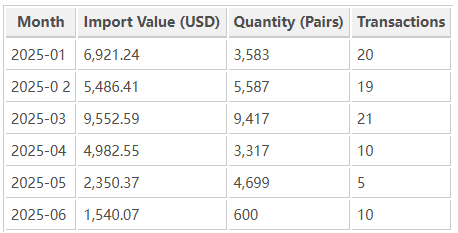
The March peak—USD 9,552.59 with over 9,400 pairs imported—suggests restocking activity for retail stores ahead of mid-year sales. Subsequent months show slower but steady imports, typical for smaller African consumer markets where footwear sales fluctuate seasonally.
Leading Importers
Despite the fragmented structure of the footwear sector, several importers have emerged as key players, contributing significantly to total import volumes during the first half of 2025.
RALPH LESEGO: 12 shipments, USD 6,458.94, 3,569 pairs
SEREFETE MASAKE: 8 shipments, USD 2,589.37, 915 pairs
DOROTHY MODIAKGOTLA: 6 shipments, USD 2,534.18, 976 pairs
CN M CONSULTANCY PROPRIETARY LTD.: 4 shipments, USD 1,190.37, 615 pairs
SEEN SEAL (PROPRIETARY) LTD.: 4 shipments, USD 2,063.33, 5,944 pairs
Among these, RALPH LESEGO recorded the highest total value, partnering mainly with Chinese suppliers such as TIAN HUI IMPORT & EXPORT CO., LTD. and TIAN HUI IMPORT & EXPORT. This pattern suggests that Botswana’s shoe imports rely heavily on cost-efficient sourcing from China, particularly for leather shoes and low-cost fashion footwear.
Product Categories and Market Composition
Imported items under HS Code 64039990 cover a wide range of footwear styles, including:
-
Men’s leather and travel shoes
-
Flat shoes for men and women
-
Kids’ leather and synthetic shoes
-
Mixed footwear shipments including boots and sneakers
Most imported products fall into the mid- to low-price segment, catering to Botswana’s general consumers and informal retailers. The diversity of product types—ranging from formal office wear to children’s shoes—reflects a market driven more by affordability than by global brand competition.
Source Countries and Trade Flow
Botswana imported shoes primarily from China, South Africa, India, and Namibia during the first half of 2025.
-
China remains the leading exporter, providing nearly 70% of total shipments, mainly through small trading firms such as XINGBANG TRADING CO., LTD., SAMMU INTERNATIONAL TRADE, and YIWU SJO INTER CO., LIMITED.
-
South Africa serves as a regional distribution hub, re-exporting shoes to Botswana due to its established retail logistics network.
-
India supplies specific categories of leather shoes and safety footwear in small volumes.
This trade pattern highlights Botswana’s dependence on Asian imports, with regional re-exports from neighboring countries playing a supportive role in market supply.
Market Insights
-
Retail-driven imports — The footwear market in Botswana is primarily driven by informal retail and small boutiques that import limited quantities directly from overseas suppliers.
-
Dominance of Asian suppliers — China continues to dominate supply, while South Africa remains the main transit and wholesale hub.
-
Product diversity but low brand penetration — Unlike neighboring South Africa, Botswana’s footwear market remains price-sensitive, favoring affordable products over branded items.
-
Seasonal purchase behavior — Imports typically increase in the first quarter and before festive shopping seasons.
These factors suggest a price-sensitive market with consistent, small-volume orders reflecting the country’s modest retail capacity.
Outlook
In the second half of 2025, Botswana’s footwear imports are expected to stabilize, supported by steady consumer demand and gradual economic recovery in the retail sector. As domestic distribution channels improve, small importers may expand their operations by partnering with wholesalers in China and South Africa.
The overall trend points toward a sustainable but low-margin market, where success depends on cost control, consistent quality, and logistical efficiency rather than premium branding.
Conclusion
The first half of 2025 shows that Botswana’s footwear import market remains dynamic despite modest volume. With total imports surpassing USD 30,000, the country’s demand is sustained by growing urban populations and increased retail diversification.
The predominance of small traders highlights a resilient, consumer-oriented economy that continues to rely on imports to meet local fashion and utility needs.
Data Source: Compiled from NBD DATA international trade platform.
For detailed analytics and data services, visit https://en.nbd.ltd/service.