
From Ningbo to Dar es Salaam: Hammer Trade Reflects Tanzania’s Construction Boom
Between January and June 2025, Tanzania’s import activity under HS Code820520000000
According to NBD DATA
The bulk of this trade originated from China, particularly industrial hubs such as Ningbo and Yiwu, underscoring the strategic role of Chinese manufacturers in supplying affordable, mass-produced hand tools across East Africa.
Commonly imported product types included claw hammers, sledge hammers, demolition hammers, and rubber mallets—products essential to both construction sites and hardware retail outlets in Tanzania’s fast-growing cities.
Monthly Import Trend (2025-01 to 2025-06)
Tanzania’s hammer imports fluctuated slightly over the six-month period but maintained an overall upward trend, peaking in February and March, when infrastructure material demand intensified.
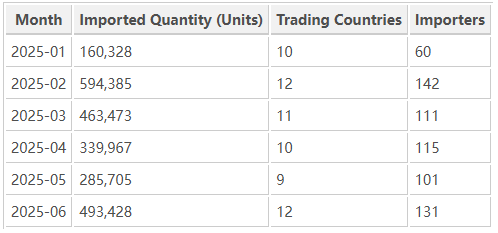
The strong activity observed in February and March coincided with Tanzania’s fiscal year infrastructure disbursements and the start of new public housing and transport projects.
By contrast, imports in April and May saw minor adjustments as logistics costs temporarily rose, before rebounding in June with renewed restocking by wholesalers.
Market Observation: Key Buyers and Suppliers
Leading Tanzanian Importers
Trade records highlight the diversity of local importers, from industrial supply chains to construction hardware retailers. The top importers during the first half of 2025 include:
These companies collectively handled hundreds of thousands of imported hammers, serving both retail networks and large-scale building contractors.
Particularly notable is the participation of engineering-related firms like SHANDONG LUQIAO GROUP CO., LTD., which supports Chinese-funded infrastructure projects in Tanzania and imports tools directly for internal site operations.
Major Global Suppliers
Chinese suppliers dominate Tanzania’s hammer imports, accounting for more than 80 percent of total volume. Key exporters include:
These firms operate out of China’s hardware manufacturing clusters, particularly Yiwu (for light hand tools) and Ningbo (for forged steel and industrial tools).
Through efficient e-commerce systems and bulk logistics channels, they supply Tanzanian distributors such as NEW JARIFASHION LTD. and HOME CITY INTERNATIONAL, often via maritime routes to Dar es Salaam Port.
The scale of these flows indicates the maturity of cross-border trade infrastructure between China and East Africa — a network built on decades of tool manufacturing capacity and Belt & Road–linked transport corridors.
Trade Geography: China as the Central Source
The trade concentration pattern is clear — China remains the dominant origin country for hammers imported into Tanzania, both in terms of unit quantity and product variety.
Additional minor sources include the United Arab Emirates (serving as re-export hubs for Chinese goods), as well as India and Turkey, which contribute specialized items such as electric demolition hammers and industrial drill accessories.
Tanzania’s importers show strong preference for suppliers offering ready-made branding and customized packaging, enabling them to retail Chinese products under localized names in hardware markets throughout Dar es Salaam, Arusha, and Mwanza.
This structure emphasizes how industrial cooperation between Chinese exporters and African wholesalers continues to shape the regional construction supply chain.
Product Insights: From Claw to Sledge
Customs samples show a broad spectrum of hammer types imported during this period:
-
Claw hammers (250 g – 1 kg) for carpentry and household use
-
Sledge hammers and demolition hammers for construction and mining
-
Rubber and nylon hammers for tile installation or mechanical repair
-
Electric hammers and rotary drills for infrastructure and road maintenance
-
Specialized items such as ball-peen hammers and copper/rawhide hammers
The diversity of these products reflects the modernization of Tanzania’s building and manufacturing sectors. With the government’s focus on domestic industrialization, demand for hand tools — including hammers — is expected to remain strong.
Market Outlook
Tanzania’s hammer import market in 2025 is a microcosm of the country’s wider economic transformation. As national infrastructure spending rises, construction material demand accelerates, and small-scale traders expand retail distribution networks across East Africa.
Three macro trends stand out for the second half of 2025 and beyond:
-
Sustained Urbanization: Rapid population growth in Dar es Salaam drives continuous construction, ensuring ongoing tool demand.
-
Regional Integration: East African Community logistics improvements are lowering import costs, allowing Tanzanian distributors to serve neighboring markets.
-
Supplier Consolidation: A handful of established Chinese exporters are deepening partnerships with Tanzanian hardware importers, formalizing long-term supply contracts.
While local tool manufacturing capacity remains limited, Tanzania’s consistent import activity highlights a stable, expanding consumer and industrial base.
For Chinese manufacturers, this market represents not only a reliable export channel but also a testing ground for branding and after-sales service models in Africa.
Data Source
All figures in this report are derived from NBD DATA
For tailored trade insights or partner verification, please visit NBD DATA Service