
Global Reach of Indian Automotive Exports: The 2025 Clutch Component Market
In 2025, India solidified its role as one of the world’s top suppliers of vehicle clutch parts and assemblies under HS Code 87089300, meeting the growing demand of automotive and machinery manufacturers across more than 160 countries. According to NBD DATA, the total export value of these components reached USD 134.24 million, spanning 89,430 shipments. With participation from 1,468 Indian exporters and 4,270 international buyers, the data underscores India’s expanding footprint in the global automotive supply chain.
Customs descriptions commonly include “clutch assemblies,” “pressure plates,” “friction discs,” “hydraulic clutch master cylinders,” and “driven plates,” which together illustrate India’s technical diversity in clutch component manufacturing.
Monthly Export Overview
India’s export flow remained consistent throughout 2025, with notable peaks in September and July — months that coincide with high-volume purchasing from global OEMs and distributors.
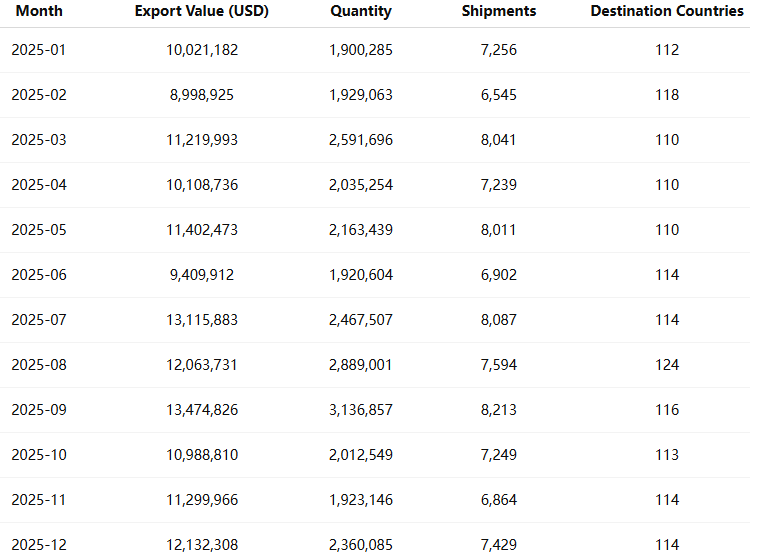
The highest monthly export value — USD 13.47 million in September — reflected strong shipments to Europe, Africa, and Southeast Asia. Meanwhile, an average monthly trade value exceeding USD 11 million confirmed steady global demand for Indian-made clutch systems.
Leading Indian Exporters
India’s clutch component export sector is driven by automotive manufacturers and engineering leaders with global distribution networks. The following five exporters represent the top performers in 2025:
These firms dominate India’s automotive parts exports, leveraging precision manufacturing, advanced clutch technology, and strategic partnerships with global automotive OEMs.
Major International Buyers
India’s exports of clutch assemblies and parts reached more than 160 international destinations, led by automotive manufacturers and distributors in Asia, Europe, and Latin America. The most prominent importers included:
-
PT. SUZUKI INDOMOBIL SALES (Indonesia)
-
JOHN DEERE MEXICO SARL (Mexico)
-
MAGYAR SUZUKI CORPORATION LTD. (Hungary)
-
SIPRADI AUTO PARTS PVT. LTD. (Nepal)
Together, these buyers highlight India’s robust integration into OEM and aftermarket supply chains, with Indian parts supporting vehicle assembly operations and spare parts markets around the world.
Regional Trade Highlights
-
Asia-Pacific: Indonesia, Japan, and Thailand remained major destinations, reflecting strong trade ties with regional automotive hubs.
-
Europe: Hungary, the UK, and Germany continued to import advanced clutch assemblies for OEM applications.
-
Latin America: Mexico, Brazil, and Chile showed consistent demand for Indian clutch discs and pressure plates, mainly for passenger and commercial vehicles.
-
Africa: Kenya, South Africa, and Nigeria imported high volumes of clutch systems for aftersales and re-export distribution.
This global spread underscores India’s ability to serve multiple market segments — from original equipment manufacturing to agricultural machinery and replacement components.
Industry Insights
Indian manufacturers’ success in exporting HS 87089300 products is underpinned by several key advantages:
-
Cost efficiency: India’s competitive labor and production costs enable lower unit prices without compromising quality.
-
Technology adoption: Integration of precision machining, automated testing, and hybrid clutch technology has improved product performance.
-
Diversified markets: No single region dominates demand, reducing exposure to regional economic fluctuations.
As hybrid and electric vehicles increasingly require dual-clutch and regenerative braking-compatible systems, India’s component makers are adapting production lines to meet the next generation of global automotive needs.
Conclusion
India’s 2025 export performance in HS Code 87089300 — valued at over USD 134 million — demonstrates its pivotal role in the global automotive supply chain.
With leading exporters such as Maruti Suzuki, Bajaj Auto, Schaeffler, Renault India, and Ashok Leyland, the country continues to deliver advanced clutch technology to vehicle manufacturers worldwide.
Looking ahead, India’s combination of engineering expertise, cost competitiveness, and growing manufacturing capacity will further cement its position as a global hub for automotive drivetrain components.
For comprehensive importer data and trade analytics, visit NBD DATA