
Trade Insights: Uzbekistan’s 2025 Import Performance for Gaskets, Seals, and Engine Parts
During the first half of 2025, Uzbekistan’s imports under HS Code 8484900000—covering gaskets and seal kits for industrial machinery, automotive engines, and heavy equipment—showed a clear upward trajectory. According to data from NBD DATA, the total import value reached approximately USD 4.82 million, with a corresponding weight of around 158,879 kilograms across 2,000 transactions involving 32 partner countries and more than 290 importing companies.
Products in this category typically include mechanical seals, engine gasket sets, O-rings, and hydraulic sealing kits—essential components for the automotive, construction, and manufacturing sectors. Common examples found in Uzbekistan’s import records are “seal kit for gearbox,” “mechanical seal for compressor valves,” and “gasket set for Isuzu NKR engine”.
1. Overview of Uzbekistan’s Import Growth
Between January and June 2025, Uzbekistan’s import value of HS 8484900000 exhibited consistent growth momentum, despite moderate monthly fluctuations. Imports were distributed as follows:
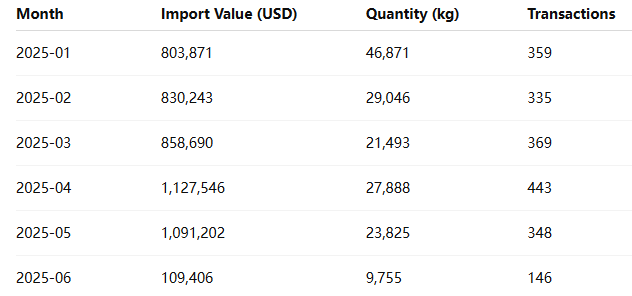
The highest monthly import occurred in April 2025, reaching USD 1.13 million, followed by May (USD 1.09 million). In contrast, June recorded a noticeable drop due to seasonal adjustments and lower customs activity.
Overall, this trend suggests stable demand from industrial buyers, especially automotive repair firms, heavy-equipment workshops, and power-plant maintenance contractors.
2. Key Importers
These enterprises highlight Uzbekistan’s diverse industrial ecosystem, covering everything from automotive assembly and energy infrastructure to agricultural machinery and mining equipment.
3. Top Foreign Suppliers
Together, these suppliers accounted for a substantial portion of Uzbekistan’s total imports of gaskets, sealing kits, and related industrial components, indicating strong commercial links with Asia and Europe.
4. Regional Trade Patterns
From a geographical perspective, China remains Uzbekistan’s dominant supplier, accounting for the majority of shipments—over 800 consignments valued at about USD 675,000. Korea followed with around USD 77,000, reflecting stable trade in automotive seal kits.
Germany, Italy, and Turkey also held notable shares, collectively contributing more than USD 800,000 worth of imports. The United States supplied fewer shipments but ranked highest by trade value at nearly USD 959,000, due to higher per-unit prices for precision-engineered sealing components.
Smaller yet technologically advanced contributions came from Japan, Finland, and the United Kingdom, providing specialized gaskets and sealing systems for industrial, mining, and power-generation use.
Overall, Uzbekistan’s import network for HS 8484900000 demonstrates a balanced mix between Asian mass suppliers and European high-quality manufacturers, ensuring both affordability and reliability in industrial supply chains.
5. Market Insights and Focus
Demand for gasket and sealing components in Uzbekistan is largely driven by three key sectors:
-
Automotive Maintenance and Assembly – Ongoing local assembly operations for brands such as Chevrolet, Hyundai, and Changan sustain consistent demand for engine and transmission gaskets.
-
Heavy Industry and Mining – Equipment from suppliers like Sandvik and Wartsila requires periodic maintenance, creating stable demand for durable industrial sealing kits.
-
Energy Infrastructure Projects – Imports connected to Mitsubishi Power underscore Uzbekistan’s growing investments in energy and power-generation facilities.
This diversified industrial demand ensures the gasket import market remains resilient, even under global trade fluctuations.
6. Summary and Outlook
Overall, Uzbekistan’s gasket and sealing component imports under HS 8484900000 totaled USD 4.82 million between January and June 2025, sourced from over 30 partner countries. This steady activity reflects the country’s expanding industrial base, with consistent demand from automotive, heavy machinery, and energy sectors.
Going forward, Uzbekistan is expected to maintain reliance on Chinese and Korean suppliers for cost-efficient mass products, while continuing to import high-grade sealing systems from Japan, Germany, and the United States. With ongoing investments in modernization and infrastructure, import volumes are projected to grow modestly through 2026.
7. Data Source
All statistics and trade insights in this report are derived from NBD DATA