
China Dominates Tanzania’s Vacuum Flask Market Amid Growing Demand
During the first half of 2025, Tanzania’s import market for vacuum flasks (HS 961700000000) recorded remarkable growth momentum. According to NBD DATA, total imports between January and June 2025 reached USD 2.92 million and more than 1.71 million units traded. Core product types include Plastic Vacuum Flask 3.2 L, Stainless Steel Vacuum Flask, and Vacuum Insulation Flask 1.3 L, demonstrating the country’s rising household and hospitality demand for affordable insulated containers.
China emerged as the predominant supplier, followed by the United Arab Emirates and Hong Kong (China). The trade pattern underscores the strong integration between Chinese light-manufacturing networks and East African consumer markets.
Monthly Import Overview
Tanzania’s import activity fluctuated moderately across the first half of 2025, peaking in February.
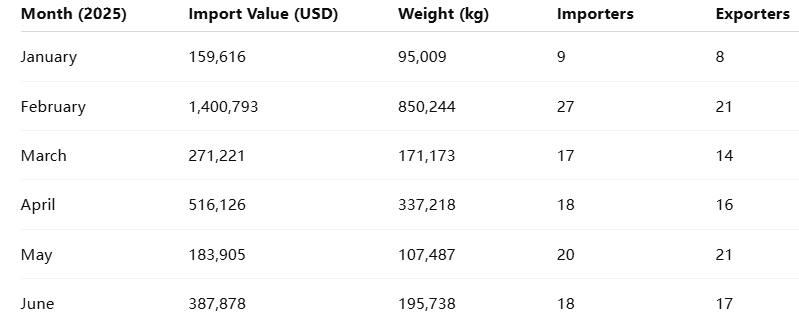
February’s spike above USD 1.4 million likely reflects pre-seasonal restocking before peak consumption months. Over the six-month span, nearly 80 importers and 59 exporters participated in this trade, highlighting a diverse but China-centered market.
Leading Tanzanian Importers
Analysis of customs data identifies the top five Tanzanian importers:
-
URHOME Company Limited — Largest buyer, accounting for USD 1.37 million (≈ 771 tons), primarily sourcing from HOUSELIFE Building Limited in China.
-
SGS Cargo Co., Ltd. — Completed 40 transactions worth USD 212 k, working with Guangdong-based suppliers such as Guangzhou Benda Trading Co. and Qirong Import & Export Trading Ltd.
-
STE Samilu Global SARL — Smaller-scale importer partnering with Yiwu Zhusang Import and Export Company.
-
Keybo Co., Ltd. — Purchased USD 76 k in flasks directly from Yiwu Miamin Trading Co. Ltd.
-
R.M. Hamza Ltd. — Maintained steady shipments from Yiwu Huatan Import & Export Co. Ltd.
These importers exemplify how Tanzania’s retail and distribution networks rely heavily on Chinese supply chains centered in Yiwu and Guangdong.
Major Exporters Supplying Tanzania
Chinese exporters dominate the supply side for vacuum flasks (HS 961700000000), with the following firms leading the trade:
-
HOUSELIFE Building Limited — Top exporter, shipping over USD 1.47 million of goods.
-
AWIE Group Co., Limited — Recorded USD 308 k in sales to multiple Tanzanian importers.
-
Yiwu Adent Trading Company Limited — Handled 57 export records totaling USD 24.9 k.
-
Yiwu Xuanying Import and Export Limited — Supplied USD 76.6 k in plastic flasks and household containers.
-
Yi Kai Import and Export Co., Ltd. — Specialized in stainless-steel flasks worth USD 156 k.
Together these suppliers reinforce China’s role as Tanzania’s central source for insulated-ware imports.
Geographic Trade Distribution
Regional data show a clear Asian concentration.
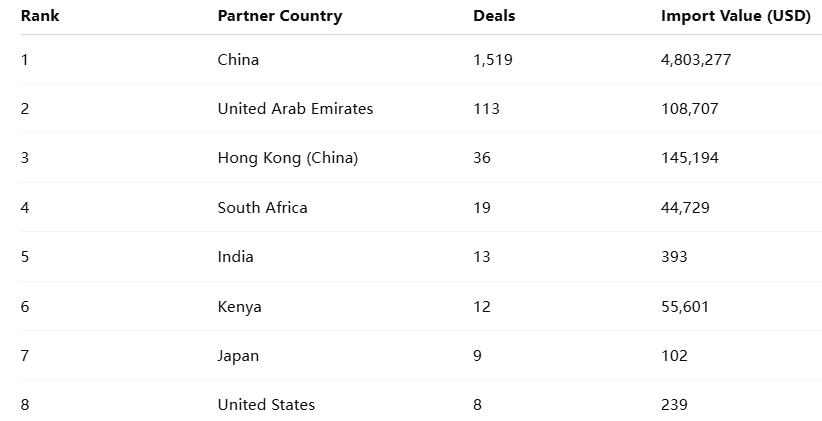
China alone contributed more than 90 percent of Tanzania’s total import value for this category.
Focus on Chinese Products
Product sampling from Chinese shipments reveals popular sizes between 1 L and 3.2 L, including:
-
Plastic Vacuum Flask 3.2 L
-
Stainless Steel Vacuum Flask
-
Vacuum Flask 1.8 L (Plastic Material)
-
Vacuum Flask 1.3 L Silver/Black Series
-
Vacuum Flask 0.9 L and 1.6 L models
These items balance affordability and durability, perfectly suited to East African household and hospitality usage.
China–Tanzania Bilateral Trade Snapshot
Trader-level statistics from NBD DATA show that URHOME Company Limited imported 213 shipments of vacuum flasks (HS 961700000000) from China, totaling USD 5.06 million and 2.87 million kg. Conversely, Tanzania’s own exports under the same code were minimal — only USD 2,565 worth of small “Chupa za chai (Thermos)” products to neighboring markets — indicating a clearly import-dependent structure.
Market Insights
Key observations on the Tanzanian market:
-
Seasonal Procurement Peaks: Major shipments coincide with pre-tourism and festive seasons.
-
Supplier Concentration: Most imports originate from Yiwu and Guangdong traders.
-
Fragmented Retail Channels: Numerous small-scale distributors dominate.
-
Stable Unit Prices: Average import price around USD 1.66 per kg.
-
Urban Consumption Growth: Expanding middle-class and hospitality sectors boost demand.
These insights highlight a structurally robust, China-anchored trade ecosystem.
Outlook
Tanzania’s imports of vacuum flasks (HS 961700000000) are expected to keep expanding through 2025, supported by urbanization and hospitality industry growth. Chinese exporters — already the main suppliers — are likely to maintain dominance by leveraging cost efficiency and rapid fulfillment through established logistics links.
Data Source
All figures and corporate information are derived from verified customs datasets analyzed by NBD DATA. For comprehensive trade intelligence and buyer-supplier analytics, visit NBD DATA Service