
Inside Kenya’s Kids’ Toy Market: Import Expansion and Leading Suppliers
From January to June 2025, Kenya’s imports of kids’ toys under HS 95030000
Typical imported items include Kids Motorised Toys, Assorted Kids Toys, and Puzzles and Recreational Models. These reflect the growing demand for affordable educational and entertainment products among Kenya’s younger population.
Monthly Import Overview
Between January and June 2025, Kenya’s toy imports maintained strong and steady performance. April and May were the most active months, accounting for over 40% of the total value. Imports rose notably in June, confirming sustained momentum into the second quarter.
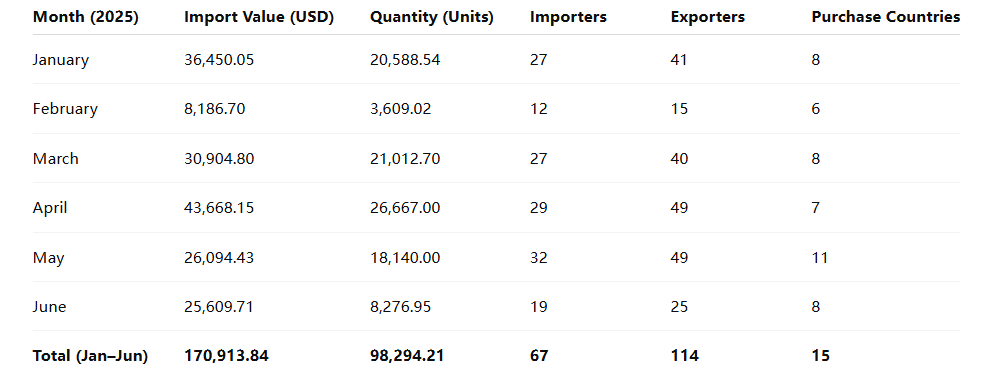
The data reveal Kenya’s consistent reliance on multiple suppliers across Asia, Europe, and the Middle East, with China remaining the dominant source due to competitive pricing and a wide range of product categories.
Market Observation
The toy import market in Kenya is composed of both commercial retailers and logistics intermediaries. Imports are often managed through regional cargo consolidation firms based in China and the UAE, supplying small and medium-sized enterprises in Nairobi and Mombasa.
Leading Importers
-
BEX CARGO LOGISTICS LTD. – A key importer handling numerous shipments of assorted kids’ toys and electric play products.
-
KLYNLINK ENTERPRISES LTD.
– Focuses on bulk retail imports from Guangzhou Nanxin Trading Co., Ltd. and similar suppliers. -
TITAN IMPEX LTD. – Deals in a variety of mid-range toys and puzzles for the domestic market.
-
NAP EXPRESS CARGO LTD. – A hybrid logistics and trading company managing imports via Dubai and Guangzhou.
-
BATES ENTITY CONSULT LTD. – Serves the regional wholesale market for affordable children’s products.
These firms are instrumental in bridging global toy production centers with Kenya’s local retail environment, where low-cost products dominate consumer demand.
Product and Source Analysis
Kenya’s toy imports can be categorized into three principal segments:
-
Electronic and Battery-Powered Toys – Motorised or interactive toys, often imported from Chinese factories in Shenzhen and Guangzhou.
-
Educational and Puzzle Toys – Low-cost items such as kids’ puzzles, building blocks, and learning kits, supporting Kenya’s early childhood education market.
-
Assorted and Generic Toys – Plastic and mixed sets sold in bulk through supermarkets and local toy shops.
China remains Kenya’s main supplier, followed by the United Arab Emirates, which acts as a re-export hub for mixed toy shipments. Smaller contributions come from India, Turkey, and the United Kingdom, usually through re-exports or niche educational product lines.
Regional Trade Insights
Kenya’s dependence on Chinese toy exports is reinforced by strong logistics links and e-commerce integration. Many Kenyan retailers use digital platforms such as Alibaba and Temu to source small-batch shipments, reflecting the increasing digitalization of Kenya’s retail imports.
Meanwhile, regional trading partners in the UAE and Turkey facilitate consolidation and forwarding services for small enterprises importing mixed product consignments. This has lowered import barriers for micro-retailers and expanded toy availability beyond major cities.
Summary
Overall, Kenya’s toy import market in early 2025 demonstrates robust activity, supported by resilient retail demand and cross-border trade networks. With over USD 170,000 in total imports and nearly 100,000 units traded in the first half of the year, the sector continues to grow as household incomes and online retail infrastructure expand.
The dominance of Chinese suppliers and the role of global freight intermediaries ensure Kenya remains a vibrant import market for children’s toys, bridging affordability, diversity, and convenience. Continued e-commerce adoption and small-scale distribution will likely sustain this growth through the remainder of 2025.
Data Source
All data are sourced from NBD DATA