
Analyzing Indonesia’s Seasoning Export Market: Key Companies, Destinations, and Monthly Trends
In 2024, Indonesia’s export market for seasoning under HS 21039019 recorded a remarkable performance, reflecting both the country’s robust food industry and the growing international appetite for Asian flavors. According to data from NBD DATA, the total export value reached 49.71 million USD, involving 45 destination countries, 202 importers, and 134 exporters.
Seasoning, encompassing spice blends, flavor powders, and instant sauce bases, plays a pivotal role in Indonesia’s processed food sector. Brands such as Indofood, Sasa Inti, and Givaudan Indonesia have established themselves as major contributors, exporting both consumer-ready and industrial-use products across Asia, Europe, and the Americas.
Monthly Export Trends
The export volume of Indonesian seasoning showed dynamic movement throughout 2024. The peak occurred in March, with an extraordinary value of 15.94 million USD, driven by bulk shipments from Indofood and Givaudan. Subsequent months stabilized, maintaining an average monthly value of around 4 million USD, signaling steady demand from key markets.
Monthly Export Overview (2024)
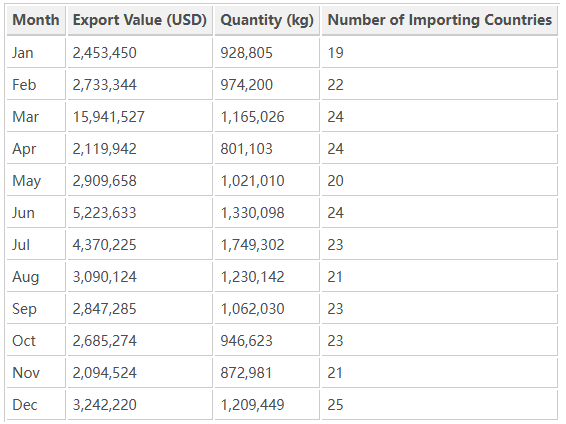
The sharp increase in March exports was likely due to major bulk orders from regional distributors ahead of the Ramadan and Eid al-Fitr seasons, when demand for packaged foods rises significantly across Muslim-majority countries.
Leading Importing Companies
Based on NBD DATA, several importers stand out for their significant trade volume and global distribution networks:
PCL SUCCESS INTERNATIONAL PVT. LTD.– the top buyer in 2024, purchasing over 275,929 kg valued at 10.61 million USD, primarily sourced from PT. Indofood CBP Sukses Makmur Tbk.
INDOFOOD (M) FOOD INDUSTRIES SDN BHD – a Malaysian affiliate of Indofood, accounting for 4.68 million USD and handling 246 million kg of seasoning products for regional repackaging.
GIVAU DAN SINGAPORE PTE LTD. – representing Givaudan Indonesia, this company managed 3.64 million USD in exports to Singapore and neighboring ASEAN markets.
NESTLE PHILIPPINES INC. – imported more than 2.06 million kg worth 3.29 million USD, reflecting Nestlé’s continued reliance on Indonesian spice bases.
HUA SUI TRADING CO., LTD.– a consistent regional distributor covering Hong Kong and Taiwan, purchasing over 6,000 kg valued at 115,911 USD.
These companies demonstrate Indonesia’s strong B2B integration across Asia’s fast-moving consumer goods (FMCG) supply chain. The close ties between Indofood and its foreign subsidiaries underline Indonesia’s vertical control over both production and export logistics.
Major Indonesian Exporters
Among 134 exporters, several key players dominate the market, each leveraging either brand strength or international partnerships:
PT. Indofood CBP Sukses Makmur Tbk. – Indonesia’s largest food producer, responsible for over 10 million USD in seasoning exports. Its brands Indofood and Indomie seasoning lines reach over 60 countries.
PT. Givaudan Indonesia – a subsidiary of Givaudan SA (Switzerland), focusing on industrial flavoring exports to Singapore and Malaysia.
PT. SASA Inti– a long-standing brand specializing in instant seasoning, soy sauce, and stock powder.
PT. Bamboe Indonesia – a niche exporter catering to gourmet markets, especially the Netherlands and Japan.
PT. Nestlé Indonesia – producing culinary mixes for Nestlé’s global subsidiaries, including Maggi flavor products.
These exporters form the backbone of Indonesia’s flavor industry, combining local spice heritage with modern processing and packaging standards.
Key Destination Regions
The 2024 export data highlights 45 destination countries, with the following regions leading in value:
-
Malaysia – the top destination, re-exporting to ASEAN and Middle Eastern markets.
-
Singapore – a trade hub for Givaudan’s and Indofood’s regional operations.
-
Philippines – supported by Nestlé’s local operations.
-
United States – steady growth from ethnic Asian food retailers.
-
Australia – increasing imports for restaurant and ethnic food distribution.
This distribution pattern shows Indonesia’s dual advantage: its geographic proximity to Asian buyers and its ability to meet Western markets’ quality standards.
Market Observations
The global seasoning trade is evolving as consumers seek authentic and convenient flavors. Indonesia’s competitive edge lies in its abundant spice base—pepper, garlic, turmeric, and chili—combined with cost-efficient manufacturing. Three major factors continue to drive growth:
-
Integration between flavor giants and local producers, led by Indofood and Givaudan.
-
Rising demand in Asia-Pacific, especially from emerging economies with growing processed-food sectors.
-
Government export incentives, reducing tariffs and supporting product standardization.
Nevertheless, challenges remain, including maintaining consistency in taste profiles across export markets and adhering to stricter labeling requirements in the EU and North America.
Conclusion
Indonesia’s seasoning exports in 2024 underscore the country’s pivotal role in shaping global taste trends. With major companies like Indofood, Givaudan, and Sasa Inti leading production, and regional affiliates in Malaysia and Singapore managing distribution, Indonesia is positioned as Asia’s flavor powerhouse. As global demand for diverse and ready-to-use seasonings continues to grow, Indonesia’s export value is expected to climb further in 2025.
Data Source
This report is based on verified trade data from NBD DATA, covering real shipment records for 2024. For enterprise-level insights or full exporter profiles, please visit NBD DATA Services.