
Cable Imports into the Philippines Reach USD 26 Million, Driven by Electronics and Industrial Demand
During the first half of 2025, the Philippines imported CABLE products (HS Code 85444949000) worth approximately USD 26.28 million, according to verified data from NBD DATA. These imports covered a wide range of items such as network, power, instrumentation, and control cables, which are widely used in electronics manufacturing, telecommunications, and industrial automation. Typical shipment descriptions include USB Cable, Instrumentation and Control Cable, Computer Cable (XYY Brand), LAN Cable, and Low Voltage Cable—illustrating the diversity of demand from both consumer and enterprise sectors.
The imported cables mainly serve the country’s growing electronics ecosystem, supporting manufacturers of smartphones, semiconductors, and industrial equipment. As the Philippines strengthens its position as a regional electronics assembly hub, the inflow of advanced cabling components from Asia and Europe continues to accelerate.
Monthly Trend Overview
Between January and June 2025, cable import activity remained relatively stable, with total transaction records reaching 3,028, covering 43 source countries, 537 importers, and 716 exporters.
In value terms, monthly imports fluctuated between USD 3.1 million and USD 7.5 million:
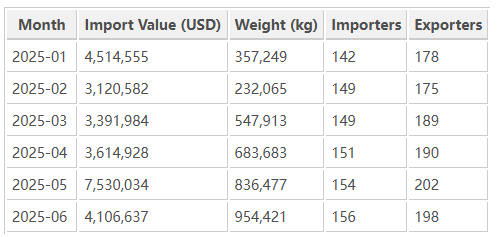
Overall, May 2025 marked the highest monthly import value—more than USD 7.5 million, representing strong procurement for telecom and computing cable types. The steady rise from February to May coincided with the launch cycles of major electronic brands and seasonal restocking of network accessories.
Market Observation
The cable import market in the Philippines demonstrates a diverse industrial base, yet the electronics sector continues to dominate.
Leading importers include:
Huawei Technologies Phils Inc., sourcing mainly from its Singapore-based affiliate Huawei International Pte Ltd.
Acbel Polytech Philippines Inc., mostly for power supply systems and electronic assemblies.
Zenith United Electric Corp., a key distributor of electrical and low-voltage cables.
Knowles Electronics (Philippines), specialized in acoustic components, sourcing precision connection cables from China and Japan.
Samsung Electronics Philippines Corp., focusing on small-scale wire harnesses for consumer devices.
The supplier landscape is equally global. Major exporters include:
Huawei International Pte Ltd. (Singapore)
RS Components Limited (United Kingdom)
Helukabel Cable Manufacturing(Germany)
Huizhou D and S Cable Co., Ltd. (China)
Together, these suppliers represent the technological backbone of the Philippine cable import chain, providing products from high-flex industrial cables to miniature connectors for electronics assembly. Their combined shipments account for more than half of total cable import value in the period.
Trade Regions and Country Focus
The Philippines imported cables from 43 countries, yet the bulk of shipments originated from China, Singapore, Japan, Germany, and South Korea.
-
China remains the dominant supplier, delivering low-voltage and instrumentation cables essential for industrial and electronic manufacturing.
-
Singapore plays a crucial role as a re-export hub for brands like Huawei and Molex.
-
Japan continues to supply precision and sensor cables for automotive and semiconductor assembly lines.
-
Germany and South Korea contribute high-quality industrial and communication cables, often used in automation and control systems.
Typical Chinese-origin products include Instrumentation Cable 1×2×1.5 mm², Low Voltage Cable 4×20, and PVC Power Cable 3×95 + 3×16 mm², demonstrating China’s focus on mass-produced yet reliable industrial components.
Focus Country: China
China remains the Philippines’ primary trading partner for cable imports. Shipment descriptions referencing Chinese exporters such as Huita Electric Dong Guan and Huizhou D and S Cable reveal a wide variety of goods—ranging from Hook-Up Cables (AWG 18) and LAN Cables to Power Cables for Production Use. This diversified supply structure indicates how Chinese manufacturers align their offerings with the growing electronics and telecommunication sectors in the Philippines.
Industry Context
The growth of the Philippine electronics manufacturing sector continues to drive cable import demand.
-
Telecommunications expansion: The ongoing rollout of 5G and fiber networks by major telecom operators increases the need for optical and copper cables.
-
Semiconductor assembly and testing: Local operations by global giants like Samsung and Knowles depend on precision cables for sensors, connectors, and internal assemblies.
-
Consumer electronics: The rising domestic assembly of smartphones, tablets, and appliances sustains consistent imports of USB, LAN, and power cables.
Moreover, the presence of distribution firms such as RS Components ensures that smaller industrial users can access international brands’ cabling solutions efficiently.
Summary and Outlook
From January to June 2025, the Philippines’ cable imports totaled USD 26.28 million, involving more than 500 importers and 700 exporters. While monthly variations reflect project cycles and procurement schedules, the long-term trend suggests sustained demand aligned with the nation’s electronics and infrastructure development.
Looking ahead, the country’s strategic participation in regional electronics supply chains will continue to attract imports of specialized cables for communication systems, semiconductor devices, and industrial control. With continued investments in smart manufacturing and broadband connectivity, cable imports are expected to maintain a positive trajectory through 2026.
Data Source Statement
All figures and company details in this article are derived from verified customs transaction data processed by NBD DATA.
The information covers the period January 1 – June 30, 2025, based on the Philippines import dataset (dataType 321).
For enterprise-level access to importer/exporter intelligence, please visit NBD DATA Service.