
Sri Lanka Expands Imports of Engine Fuel Pumps to Support Transportation Demand
In the first half of 2025, Sri Lanka recorded notable growth in its imports of engine fuel and oil pumps under HS Code 84133000, totaling USD 1.60 million, according to NBD DATA. These products—integral to internal combustion engines—are essential for the operation of vehicles, industrial machinery, and power generators.
The increase in import volume reflects the continued recovery of Sri Lanka’s automotive and transport sectors, which are expanding in response to infrastructure investment, logistics growth, and the demand for reliable public and private transportation systems.
Monthly Import Trends
From January to June 2025, Sri Lanka’s imports of fuel pumps fluctuated moderately but maintained an upward trajectory overall. The highest monthly import value was observed in March, when industrial and automotive orders surged.
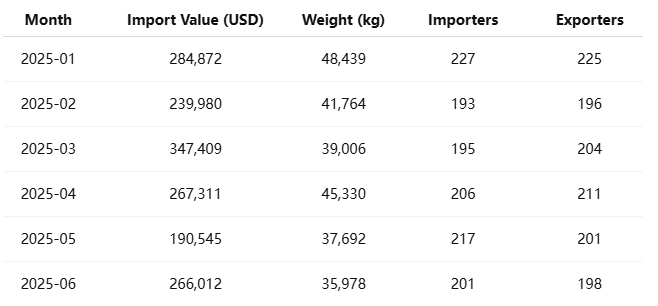
This sustained performance indicates stable procurement by automobile assemblers, importers, and service networks. The modest dip in May corresponded with supply adjustments following strong Q1 demand.
Market Observation: Key Buyers and Suppliers
Top Sri Lankan Importers
Top Global Suppliers
These leading companies underscore a regional supply chain centered around India, Japan, and South Korea, complemented by European automotive brands like Mercedes-Benz and Mitsubishi that serve the premium vehicle segment in Sri Lanka.
Trade Regions and Country Analysis
The trade landscape for fuel pumps in Sri Lanka remains diverse, with over 34 source countries recorded during the first six months of 2025.
While India retained its traditional dominance as Sri Lanka’s primary source for automotive components, suppliers from Japan, Germany, and China contributed significantly across different product categories.
Indian and Japanese exporters collectively account for over two-thirds of Sri Lanka’s import value for HS 84133000, driven by their strong presence in both passenger and commercial vehicle markets.
China’s participation is expanding, particularly in providing aftermarket and replacement pumps that cater to small workshops and secondary service channels.
The consistent inflow from Germany and South Korea highlights the importance of high-efficiency and precision-engineered parts in Sri Lanka’s modern automotive maintenance sector.
Regional Focus: The Asia-Pacific Supply Network
The 2025 data illustrate Sri Lanka’s deep integration into the Asia-Pacific automotive supply chain.
Companies such as Tata Motors, Toyota Tsusho, and Hyundai Mobis play key roles in ensuring the steady availability of genuine parts. These relationships also support the country’s vehicle assembly, repair, and distribution industries, which are vital for domestic mobility and logistics.
Additionally, the participation of European OEMs like Mercedes-Benz and Mitsubishi Fuso Truck and Bus indicates that Sri Lanka continues to import high-end parts for fleet maintenance, ensuring compatibility with global standards in fuel system performance and emissions control.
Summary
Sri Lanka’s imports of engine fuel and oil pumps under HS 84133000 reached USD 1.60 million in the first half of 2025, involving 697 importers and 707 exporters.
The consistent trade activity demonstrates a growing reliance on automotive and industrial spare parts, driven by infrastructure investment, logistics expansion, and consumer demand for reliable vehicles.
As the transportation sector continues to evolve, Sri Lanka’s import structure reflects a balance between regional sourcing efficiency and technological diversity—anchored by long-term trade with India and Japan, and supported by expanding networks across Asia and Europe.
Data source: compiled by NBD DATA based on global trade intelligence systems. For professional data services, please visit NBD DATA Service