
Market Focus: Distributors Drive Pakistan’s Growing Demand for Laptops
In the first half of 2025, Pakistan’s laptop import market under HS Code 84713010 showed steady expansion, reflecting a growing appetite for digital devices in both consumer and enterprise segments.
According to NBD DATA, the total value of laptop imports reached approximately USD 28.2 million, with a cumulative 163,353 units imported across 999 transactions. Despite modest quarterly fluctuations, Pakistan’s technology distributors maintained consistent import activity from major supply centers such as China, the United Arab Emirates, and the United Kingdom.
Product Scope and Market Context
HS 84713010 covers portable automatic data processing machines—essentially laptops, notebooks, and ultrabooks.
In Pakistan, demand growth in early 2025 was supported by rising digital learning initiatives, the continued expansion of e-commerce, and hardware procurement by both public and private institutions.
The imported products spanned a broad range of models from entry-level Chromebooks to premium business and gaming laptops from brands like Dell, Lenovo, HP, and MSI.
Monthly Import Trends
Monthly import data reveals active trade cycles and procurement peaks aligned with the academic and fiscal calendar.
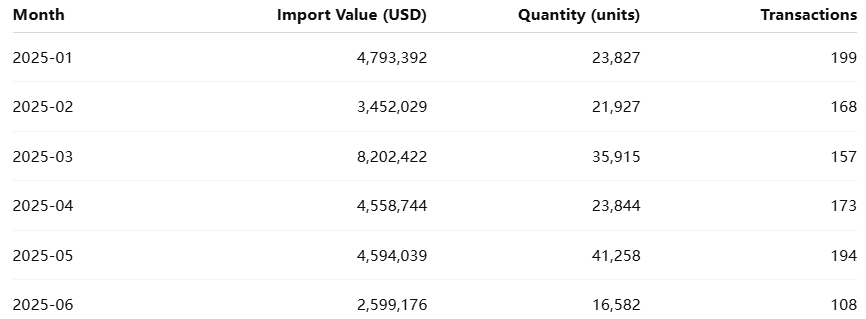
The highest import value occurred in March 2025, exceeding USD 8.2 million, reflecting large institutional orders and corporate renewals.
A minor dip in June likely correlates with pre-budget import slowdowns and inventory adjustments before the second half of the fiscal year.
Major Importers in Pakistan
The Pakistani laptop market continues to rely on key distributors and IT retailers who connect global suppliers with domestic wholesalers and end users.
-
M/S SNP DISTRIBUTION — imported 4,399 units worth USD 1.82 million, sourcing mainly from Singapore-based distributors such as SPECTRA INNOVATIONS PTE LTD and POP GLOBAL DISTRIBUTION PTE LTD.
-
MULLER & PHIPPS PAKISTAN (PRIVATE) LTD. — handled 6,525 units, valued at USD 2.66 million, closely linked with MULLER AND PHIPPS (SINGAPORE) PTE LTD.
-
M/S INTERNATIONAL OFFICE PRODUCTS (PRIVATE) LTD. — imported 1,607 laptops worth USD 1.95 million, primarily from LENOVO PC HK LTD.
-
SHAHNAWAZ PVT. LTD. — imported 581 laptops valued at USD 0.58 million, mainly Dell models from DELL GLOBAL B.V.
-
HAJVERY TRADERS — imported 5,578 units totaling USD 0.46 million, sourcing from N H TRADING (UK).
Together, these five firms accounted for nearly 45% of total import value during the first half of 2025, establishing Pakistan’s principal distribution framework for branded laptops.
Leading Global Export Partners
The import network is powered by multinational suppliers and distribution hubs concentrated in Asia and Europe.
-
China continues to dominate as Pakistan’s largest manufacturing and export source for assembled laptops and OEM models.
-
The United Arab Emirates serves as a key re-export hub for electronics, providing access to brands through regional trade networks.
-
The United Kingdom and the United States supply branded and refurbished laptops for corporate and consumer channels.
-
Malaysia supports partial assembly and re-export operations, especially for HP and Dell devices.
This structure emphasizes Pakistan’s integration into the global IT distribution ecosystem, where supply chain efficiency and brand diversity are critical drivers.
Trade Region Overview
According to customs transaction data from the first half of 2025, Pakistan imported laptops from 32 countries, with the top five origins listed below:
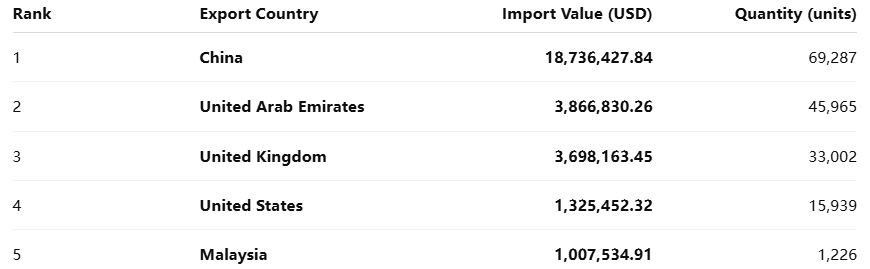
China is the dominant exporter, accounting for more than 66% of total import value and the majority of imported units.
The UAE and UK act as important regional intermediaries for re-exported and refurbished laptops, while the US and Malaysia contribute specialized or brand-specific shipments.
Market Insights
-
E-commerce Expansion: Online retail platforms such as Daraz.pk boosted imports of mid-tier laptops catering to remote work and educational use.
-
Corporate and Educational Procurement: Government-led digitization programs supported bulk orders for laptops in the education and public sectors.
-
Supply Chain Diversification: Partnerships with re-export hubs like the UAE enabled Pakistani distributors to maintain flexible sourcing amid shifting global logistics.
These dynamics highlight Pakistan’s ongoing digital transformation, supported by a resilient import network spanning Asia, the Middle East, and Europe.
Outlook
Given current demand momentum, Pakistan’s laptop imports are expected to grow 10–12% year-over-year through the second half of 2025.
E-learning initiatives, currency stability, and new supply agreements with Asian manufacturers will likely sustain import activity and market growth.
Data Source
All statistics and insights in this report are derived from customs transaction data compiled by NBD DATA. For further analytical tools and access to enterprise profiles, please visit NBD DATA Services.