
India's September 2024 Import Data: Key Insights, Top Trade Partners, and Shifts in Global Supply Chains

Publishing Date:2024-10-26 13:29:37 Source: NBD Data(en.nbd.ltd)

Introduction

India's global trade dynamics play a crucial role in its economic landscape, with import data offering valuable insights into consumption patterns, demand shifts, and international trade alliances. This report focuses on India's September 2024 import data, analyzing trends, shifts, and top trade partners to provide businesses and stakeholders with actionable intelligence on India's import market. Through examining the latest customs data, this report sheds light on the primary products driving India’s imports, key suppliers, and emerging trade patterns. This comprehensive analysis is essential for companies aiming to expand their reach within the Indian market.

India’s September 2024 Import Overview

In September 2024, India recorded a total of 4,838,320 import entries, reflecting a 3.6% decrease from August's 5,019,114 entries, yet a substantial year-over-year increase of 10.6%, underscoring significant long-term growth in demand. Total import expenditure amounted to $57.48 billion, marking an 18.3% monthly decline from August’s $68.04 billion but a notable 4.9% rise compared to $54.79 billion in September 2023.

  • Procurement Trends: Active buyer entities in India grew to 60,076, representing a 1.4% increase from last month and a marginal year-over-year increase of 52 buyers. This stable buyer growth indicates continued demand across various sectors.
  • Supply Chain Dynamics: The number of supplier entities recorded for September reached 112,394, with a minor month-over-month increase of 0.5% and a 1.1% year-over-year rise, reflecting a steady supply network actively participating in India’s import market.

This overview highlights both short-term fluctuations and long-term growth in India’s import activities, aligning with global trends that emphasize India's expanding role in international trade.

Top 5 Import Products in India – September 2024

In September 2024, India’s top imported products span a diverse range of sectors, reflecting the country’s varied demand across industries. Below is an analysis of the top five import categories, represented by their Harmonized System (HS) codes, along with changes in monthly and yearly import values.

  1. HS Code 270900 – Crude Petroleum Oils
    With a total import value of $9.85 billion this month, crude petroleum (HS 270900) remains India’s leading import category. Despite a 9.1% decline from August, demand remains high, showing only a modest year-over-year decline of 1.2%. This consistent demand reflects India’s growing energy needs.

  2. HS Code 710812 – Gold (Non-monetary)
    Gold (HS 710812) imports recorded $4.51 billion in September. While gold imports dropped by a significant 49.5% month-over-month, there was a 83% increase compared to September last year, indicating a heightened interest likely driven by festive season preparations and rising investment appeal.

  3. HS Code 270119 – Coal, Other than Anthracite or Bituminous
    Imports of non-anthracite coal (HS 270119) reached $2.04 billion. Although imports fell by 16% from the previous month, year-over-year values remain steady, indicating continued reliance on coal for industrial use despite seasonal fluctuations.

  4. HS Code 851779 – Communication Equipment
    Communication equipment (HS 851779) surged to $1.60 billion in September, marking a 9.9% increase from August and an impressive 34.5% increase year-over-year. This category's growth underlines India’s expanding digital and telecommunication needs.

  5. HS Code 854231 – Semiconductors
    Semiconductor imports (HS 854231) stood at $1.45 billion, a minor 7.6% month-over-month decrease, yet a strong year-over-year growth of 20.4%, reflecting India’s increasing investments in technology and electronics manufacturing.

The data from these top categories reveal India's priority for energy, investment commodities, and high-tech products, emphasizing its evolving import needs.

Recommended Buyers for Major Products in India

Several Indian buyers actively engage in procuring these top imports, particularly in the energy, precious metals, and electronics sectors. Below are some prominent importers and their associated details.

  1. HS Code 270900 – Crude Petroleum Oils

  2. HS Code 710812 – Gold (Non-monetary)

  3. HS Code 851779 – Communication Equipment

These companies serve as pivotal players in India's import landscape, establishing significant connections within international trade and influencing demand in crucial product categories.

Analysis of Imports from China

India’s import relationship with China remains significant, particularly for electronics, machinery, and advanced technology products. In September 2024, the leading imports from China included:

  • HS Code 851779 – Communication Equipment: Total imports from China were $1.45 billion, up by 12.6% from August and 35% year-over-year, driven by India’s demand for telecom equipment.
  • HS Code 847130 – Portable Digital Computers: With imports valued at $616 million, this category saw a 12.1% monthly decline and a 21.5% year-over-year decrease, reflecting fluctuating demand.
  • HS Code 854231 – Semiconductors: Imports were recorded at $520 million, with a minor decrease from August yet stable year-over-year figures, highlighting India’s steady demand in the tech manufacturing sector.
  • HS Code 854232 – Electronic Integrated Circuits: Imports amounted to $296 million, showing slight growth over the past year due to India’s ongoing focus on electronics.
  • HS Code 854239 – Electronic Components: Totaling $247 million, this category had minor month-to-month fluctuation and a yearly decrease, suggesting shifts within the supply chain.

This import pattern emphasizes India's dependency on China for technological and electronic components crucial to the country's industrial growth.

India’s Top Trade Partners

India’s trade network spans various regions, with China, the United States, and the United Arab Emirates (UAE) being key partners. Below is an overview of India’s top 10 trade partners and their respective trade values for September 2024.
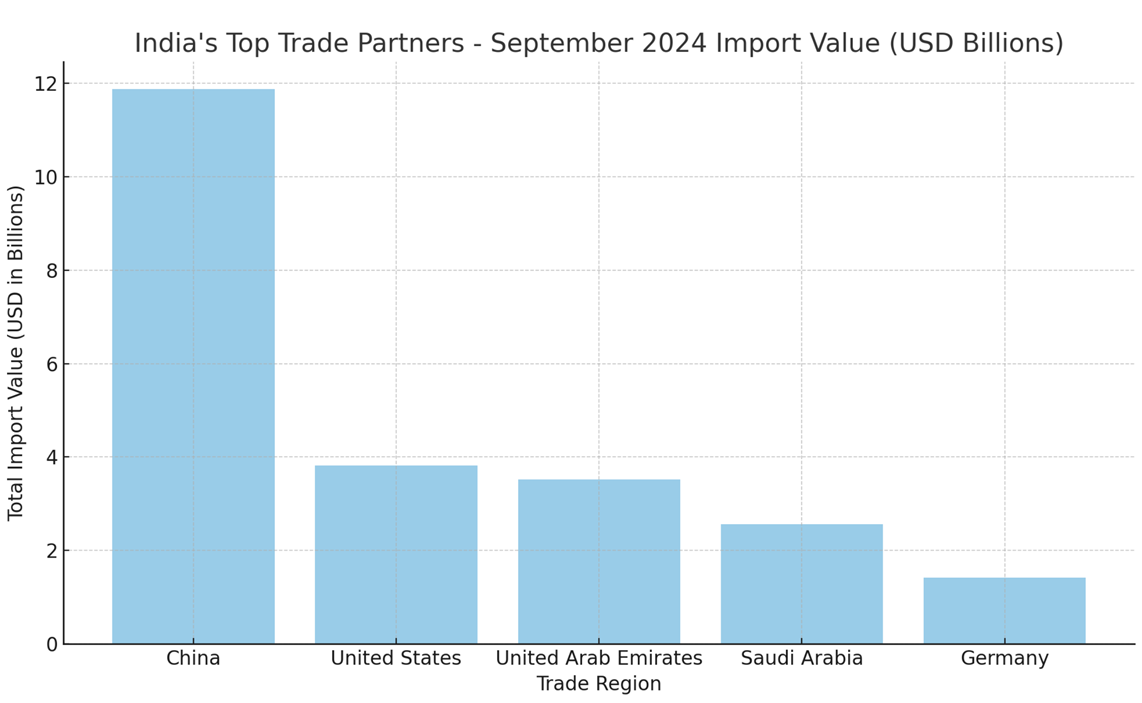

This analysis reveals the consistent role of China as India’s top trade partner, complemented by strong trade relations with the U.S. and Middle East nations.

Exchange Rate Trends

The Indian Rupee (INR) has experienced fluctuations against the U.S. Dollar (USD) over the past 12 months, with recent trends suggesting potential future adjustments. Below is the latest exchange rate analysis for the period from October 2023 to September 2024.

The exchange rate has shown an average value of 83.51 INR per USD in recent months. Future projections indicate possible stability or slight adjustments depending on international economic conditions, monetary policy, and trade volumes.

Conclusion

India’s September 2024 import data reflects a complex landscape shaped by diverse sector demands and dynamic trade relationships. The country’s reliance on energy imports, such as crude oil and coal, alongside a growing need for high-tech components like semiconductors and communication equipment, underscores its position as a major player in global trade. Partnerships with countries like China, the United States, and the UAE continue to anchor India’s import ecosystem, while shifts in the Indian Rupee exchange rate highlight economic fluctuations that may influence future import strategies.

For businesses looking to navigate or expand within the Indian market, these insights provide a roadmap to understanding India’s import trends and opportunities. NBD Data remains committed to delivering comprehensive, data-driven analyses to equip companies and stakeholders with the intelligence needed to thrive in an evolving global market.


Related Recommendations

Offer

Ecuador’s July 2025 Imports Surge 14.05% to $3.19 Billion, Led by U.S. and China Trade

2025-08-11 17:42:09

In July 2025, Ecuador’s import activity experienced a significant upswing, with total imports reaching $3.19 billion, marking a 14.05% increase compared to $2.80 billion in June. This growth was supported by 1,638,334 transaction records, underscoring strong trade activity and the resilience of the country’s import sector amid evolving global market conditions.Six-Month Trend AnalysisOver the past six months, Ecuador’s import value has demonstrated a steady upward trend, peaking in July after a moderate dip in June. February recorded $2.78 billion in imports, followed by a slight decline in March to $2.68 billion. April and May saw renewed momentum at $2.74 billion and $2.89 billion, respectively, before a drop to $2.80 billion in June. July’s rebound to $3.19 billion coincided with a notable contraction in the number of domestic importers, from 113,403 in June to 65,277 in July, suggesting concentration of larger import transactions among fewer but possibly more capital-intensive companies. Transaction volumes mirrored this contraction, dropping from 1.92 million records in June to 1.64 million in July, indicating a possible shift toward high-value goods.Top 10 Trade PartnersThe United States maintained its position as Ecuador’s top import partner in July, supplying goods worth $829 million. This trade involved 50,738 Ecuadorian importers and 2,744 U.S. suppliers, covering 2,369 product categories, with petroleum products, machinery, and electronics being key sectors.China ranked second with $682 million in imports, driven by high volumes of manufactured goods, industrial machinery, and electronics. A total of 5,389 Ecuadorian importers engaged with 6,020 Chinese suppliers, covering 2,639 categories.Panama followed with $253 million in trade, a notable share given its smaller supplier base of 261 companies serving 1,655 Ecuadorian importers. This reflects Panama’s role as a regional logistics hub for petroleum derivatives and re-exports.Colombia ranked fourth with $183 million, involving 1,721 Ecuadorian importers and 1,297 Colombian suppliers, spread across 1,526 categories, with agricultural commodities and construction materials being prominent.The remaining six partners—Peru, Brazil, Spain, Italy, Chile, and Argentina—collectively contributed a diversified import portfolio exceeding $5.0 billion annually, reflecting strong regional and intercontinental ties.Fastest-Growing Trade PartnersCambodia recorded an unprecedented surge to $55,485 from only $6 last month, reflecting a 890,513.16% growth, likely due to a large one-off shipment in textiles or specialty goods.Myanmar saw imports rise to $7,849, a 1,891.83% jump, suggesting the beginning of small-scale trade channels.Bolivia surged to $16.32 million, up 1,450.33%, largely in minerals and food products.Morocco posted $121,231, up 1,084.70%, possibly linked to increased demand for specialized industrial materials.Kuwait expanded its exports to Ecuador to $34,323, up 882.82%, potentially tied to petrochemical products.Commodity Trends and HS Code AnalysisThe fastest-growing commodity in July was HS 270750Aromatic hydrocarbon mixtures, which surged 122.28% to $220.11 million. Key buyers included EMPRESA PUBLICA DE HIDROCARBUROS DEL ECUADOR EP PETROECUADOR($130.02 million), EMPRESA DE HIDROCARBUROS DEL ECUADOR EP PETROECUADOR($89.86 million), and INDUSTRIAL LATINA S.A..HS 870121(Motor vehicles for the transport of persons, diesel-powered) grew 54.53% to $13.87 million, with major importers such as INDUSUR INDUSTRIAL DEL SUR S. A.and COMERCIAL CARLOS ROLDAN CIA. LTDA..HS 842952(Mechanical shovels, excavators, and shovel loaders with 360° rotation) increased 52.62% to $21.04 million, led by IASA S.A.and DITECA S.A.HS 852872(Color television reception apparatus) rose 50.90% to $15.30 million, with leading buyers including INTELLCARD S.A.and CAR SOUNDVISION CIA. LTDA..HS 390210(Polypropylene in primary forms) grew 50.87% to $12.36 million, with PLASTICSACKS CIA LTDA.and OBEN ECUADOR S.A.among the top buyers.Ecuador’s import sector in July 2025 displayed strong performance, underpinned by surging demand for hydrocarbons, machinery, and consumer electronics. The dominance of the U.S. and China reflects sustained global trade connectivity, while the rise of smaller partners such as Cambodia and Bolivia highlights evolving trade diversification. With energy-related imports leading the surge, Ecuador is positioned for continued trade growth, though the concentration among fewer importers suggests a strategic pivot toward large-scale, high-value transactions....

Offer

May 2025 Trade Snapshot: Colombia’s Imports Rise by 5.87%, Led by U.S. and China

2025-08-01 14:24:07

In May 2025, Colombia's total import value reached $6.13 billion, reflecting a 5.87% increase from April’s $5.79 billion. This uptick was supported by an expansion in trade activity, as the country recorded 331,782 import transactions across the month. The surge also coincided with a rise in active importers, underscoring a robust recovery in demand across key industrial sectors.Over the past six months, Colombia’s import volume demonstrated a steady upward trend, particularly after a dip in early 2025. From December 2024’s $5.65 billion, the figure declined slightly in January and February, followed by consecutive growth through March, April, and May. Notably, the number of domestic import companies climbed from 11,709 in February to 13,205 in May, while the total monthly transaction count increased by over 30,000 entries within the same period. This suggests growing commercial engagement and a diversification in sourcing activity.Among Colombia’s top ten import partners in May 2025, the United States maintained its leading position with $1.747 billion in trade value. A total of 4,258 Colombian importers were active in transactions with the U.S., involving 2,745 suppliers and over 5,700 product categories—a testament to the deep and varied commercial ties, particularly in pharmaceuticals, machinery, and electronics.China ranked second with $913 million in imports. Trade was conducted by 5,809 Colombian companies sourcing from 2,785 Chinese exporters, encompassing over 8,300 distinct product categories, the highest among all partners. This highlights China’s role as a broad-spectrum supplier, especially in consumer electronics and industrial goods.Panama stood out with $341 million in trade, facilitated by 774 Colombian firms and 1,658 Panamanian suppliers. As a strategic transshipment and re-export hub, Panama’s importance lies in its logistical advantage and flexibility across diverse commodity types.Switzerland followed closely with $325 million in imports. Although involving a relatively modest 385 Colombian importers, they engaged with 1,136 Swiss exporters in high-value segments such as chemicals, precision instruments, and medical devices.The remaining six partners—Brazil, Mexico, Germany, Korea, Chile, and even Colombia itself (for intra-national re-importation)—collectively contributed a significant volume of diversified imports. Their combined presence underscores the geographic and sectoral variety in Colombia’s external trade ecosystem.The fastest-growing trade relationships in May were led by Moldova, which recorded a 22,017.78% month-on-month surge, reaching $475,859 from just $2,151 in April. While the absolute figure remains modest, this exponential rise may reflect a new trade channel opening, likely involving agricultural or chemical goods.Croatia and Malta also saw dramatic increases—4,977.76% and 2,777.82% respectively—suggesting emerging niche trade flows or first-time large-volume contracts. Meanwhile, Andorra’s 1,689% surge and Morocco’s significant jump to $3.25 million (+714.16%) reinforce the trend of Colombia tapping into less traditional sourcing markets for specific categories.From a product perspective, urea-based nitrogenous fertilizers (HS Code 310210) topped the growth charts, up 156.48% month-on-month to $41 million. Major importers included PRECISAGRO S.A.S., NITROFERT S.A.S, and ARARAS NUTRICION S A S, reflecting heightened demand in Colombia’s agribusiness sector.In the machinery segment (HS Code 847989), imports surged nearly 100%, led by EMGESA S A ESP, THE ELITE FLOWER SAS C I, and ENERLAND 2007 FOTOVOLTAICA SL, pointing to expansion in energy and automation sectors.Television and video display equipment (HS Code 852872) recorded an 87.11% jump, with top importers such as SAMSUNG ELECTRONICS COLOMBIA S.A., ALKOSTO S.A., and LG ELECTRONICS COL LTDA.responding to rising consumer electronics demand.Pharmaceuticals (HS Code 300215) also grew significantly, with leading firms like ASTRAZENECA COLOMBIA S.A.S., MERCK SHARP AND DOHME COLOMBIA S A S, and PRODS ROCHE S Ashowing strong activity.The most valuable category remained light petroleum oils (HS Code 271012), which rose by 41.99% to a massive $325.9 million. Key importers included ECOPETROL S.A., REFINERIA DE CARTAGENA S.A, and FRONTERA ENERGY COL CORP SUC COL, underscoring continued demand from Colombia’s refining and energy sectors.In conclusion, Colombia’s import performance in May 2025 signals strong momentum, especially in high-value sectors such as energy, electronics, machinery, and agrochemicals. The rise in both volume and diversity of trade partners suggests growing resilience and complexity in the country’s trade structure. Moving forward, continued monitoring of emerging partners and product categories will be key to understanding Colombia’s evolving import dynamics....

Offer

Panama’s Import Performance in June 2025: U.S. and China Lead, Congo Surges

2025-07-30 00:24:43

Panama imported goods worth $1.23 billion in June 2025, reflecting a 4.82% decline from May’s total of $1.29 billion. The number of records filed reached 145,966, and 5,400 domestic importers were active during the period. This moderate month-on-month contraction indicates shifting demand patterns and possible seasonality effects across several key sectors.Over the past six months, Panama’s import value has fluctuated between $1.16 billion and $1.29 billion. January 2025 started strong at $1.26 billion, followed by minor volatility through April. May marked the highest value in the half-year window before June’s decline. The number of domestic importers remained stable, peaking in May with 5,452 active companies. Record volumes followed a similar trajectory, aligning closely with total trade activity.The United States remained Panama’s top trading partner in June, contributing $205 million to the import total. This trade involved 1,840 Panamanian importers and 2,929 U.S. suppliers, with goods spanning 2,276 categories. The U.S. continues to serve as Panama’s key source of industrial, technological, and agricultural products.Close behind was China, with $199 million in imports. 1,927 local buyers sourced from 3,179 Chinese exporters, covering 2,025 product types. This reflects China’s strength in consumer goods, electronics, and intermediate inputs.Mexico took third position at $55 million, with a balanced ecosystem of 485 Panamanian importers and 793 Mexican suppliers, indicating strong regional ties and cost-efficient logistics. Costa Rica followed with $41 million, backed by 308 Panamanian companies trading with 393 Costa Rican partners across 400 goods—a testament to Central American intra-regional trade.Colombia, Spain, Japan, Brazil, and Guatemala rounded out the top ten. Collectively, these partners added significant diversity, contributing both high-tech goods and essential commodities. Their combined presence underscores Panama’s multi-sourced procurement strategy.Among the fastest-growing sources of imports, Congo surged an astonishing 29,033.63%, albeit from a low base, reaching $8,524 in June. Luxembourg followed with a 2,016.73% increase, hitting $124,941. Serbia, Moldova, and Zaire all posted triple-digit percentage gains. While these countries contribute marginally in absolute terms, such spikes often signal emerging trade lanes or one-time strategic deliveries.On the product side, the top-performing categories showed impressive growth. Leading the charge was HS 100119 [wheat and meslin (excluding seed)], which surged 92.11% to $9.79 million. Key buyers included HARINAS DEL ISTMO S.A., GOLD MILLS DE PANAMA S A, and HARINERA ORO DEL NORTE.HS 230990 [non-retail dog/cat food] rose 72.13% to $10.46 million, led by EL ROBLE DEL RIO, S.A. and others.HS 854449 [low-voltage electric conductors]gained 51.91%, with major players including VIAKABLE PANAMA, S.A..HS 870333 [diesel vehicles over 2500cc]and HS 230400 [soybean oilcake and residues] grew 23.40% and 22.46%, respectively, reflecting demand in Panama’s transportation and livestock sectors.In conclusion, Panama’s import activity in June 2025 displayed mild contraction in value yet vibrant diversification across suppliers and products. The United States and China continue to dominate the landscape, while explosive growth from smaller economies signals emerging patterns worth monitoring. Agricultural goods, pet nutrition, and electric components drove product-level momentum, pointing to sustained consumption and infrastructure investment. Looking ahead, these dynamics position Panama for adaptive sourcing in a changing global trade environment....